TREND REPORT · Episode 7 · September 7, 2026
Indoor-date searches exploded — a business dug out of decision fatigue
"Summer indoor date" searches in Korea rose 81,800% as heatwaves closed the outdoors. Behind them we found decision fatigue, designed a weekly envelope that finishes the weekend plan, and asked 100 synthetic consumers whether that is worth ₩9,900 a month.
Trend we measured
"Indoor date" searches in Korea — +81,800% for "summer indoor date," city-by-city searches up 160–250%
The idea
This Week With You — a couples' subscription postcard that decides this weekend's indoor date
Price after asking 100 consumers
₩9,900 (about $7) a month for four weekly postcards
Target customer
Couples in their 20s and 30s, one to three years in — plus dual-income married couples as the hidden customer
A search term quietly exploded on Google in Korea this summer: "indoor date." The related search "summer indoor date" rose +81,800% in three months, and searches with neighborhood names attached — "Seoul indoor date," "Busan indoor date," "Hongdae indoor date" — all jumped +160–250% at once.
As heatwaves pushing 40°C (104°F) closed off the outdoors, the map of dating is being redrawn indoors. Let's go in the order of this series.
Measure the trend → find out why people react → translate it into needs and wants → an idea that solves them → check with synthetic consumers → settle on a price and a target
1. Measuring the trend: a one-summer fad?
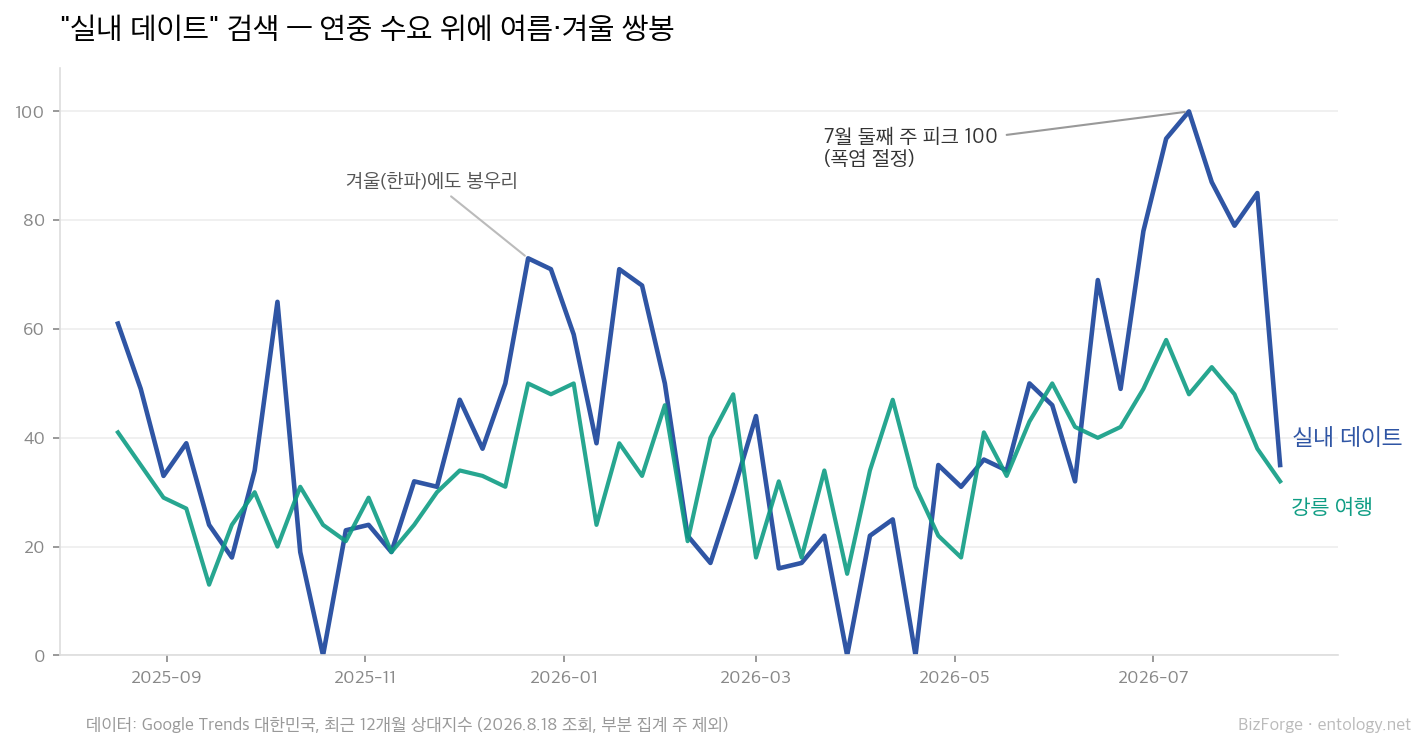
The chart is the original from the Korean report, so its labels are in Korean: 실내 데이트 is "indoor date" and 강릉 여행 is "Gangneung trip" (a popular beach getaway, used as the control).
We pulled weekly trends for the past 12 months (Aug 2025–Aug 2026) from Google Trends (relative index, peak in the period = 100).
- "Indoor date" searches: first-half average 40.7 → second-half average 43.4, with a peak of 100 in the second week of July 2026 (the height of the heatwave)
- What matters is the shape — it doesn't rise only in summer; there is a peak in the 70s in December–January too (the cold wave). A structure of year-round demand with twin peaks in summer and winter laid on top
- Over the same period, "Gangneung trip" (the control) only repeats its seasonal peaks — a contrast with the rising floor of indoor dates
In short: not this summer's flash fad, but a structural demand that climate extremes (heatwaves plus cold waves) make stronger every year. Twice a year, whenever the outdoors closes, it comes back.
2. Why do they react? — five real reasons found in reviews
Search volume only tells you "what" is rising. The business opportunity is in "why." We gathered the reasons consumers gave in their own words in real posts on Naver blogs and Cafe forums.
① Avoiding the heat is the default — "It's pushing 40 degrees, hard to even walk around these days." Weather has become the first condition for where to go on a date. They aren't escaping the heat — they search for indoor places to begin with.
② Everything converges on the shopping mall — Look for anywhere with air conditioning and you end up at The Hyundai, Starfield, or IKEA. The answers in "indoor date spots worth visiting in Seoul" posts are all alike. Cool, but boring.
③ The search labor repeats every week — The fact that "indoor date" searches jumped city by city all at once is itself the evidence. This week, and next week, the same search again. That's why "just the indoor date spots, sorted for you" curation posts pour out.
④ Wanting something special, even indoors — Reviews of escape rooms, plays, one-day classes, brand experience spaces. Not simply somewhere cool, but "an experience worth recording."
⑤ The limits of the stay-home date — A home date filled with streaming and delivery turns into boredom when repeated, and in a small studio apartment even that is a strain.
Put through BizForge's four-forces analysis (what pushes people to change, what pulls them, and the anxiety and habit that hold them back): the push is "the bad pattern of digging through Instagram's search tab for tens of minutes every time and still ending up at the same mall," and the pull is "the convenience of someone picking exactly one place that fits our neighborhood and taste." On the other side stand anxiety ("what if the recommendation doesn't fit my taste?") and habit (the hand that taps the Instagram search icon every Friday night).
3. Translating into needs and wants
Split the job of a couple in their 20s or 30s searching for indoor dates into three layers:
- Functional need — "Decide this week's indoor destination without searching." Removing the work of comparing, booking, and checking the route (①③)
- Emotional want — "The flutter of breaking out of the same routine." Relieving the boredom of the same mall and the guilt toward your partner, and looking forward to the weekend from midweek (②⑤)
- Social need — "Being recognized as a thoughtful partner who makes an effort." Giving a carefully prepared day, not a date that just gets by (④)
Lay today's products over these three layers and the gap shows.
| Function (deciding for you) | Emotion (novelty, flutter) | Social (proof of effort) | |
|---|---|---|---|
| Instagram and blog curation (free) | ✕ saved posts just pile up | △ polluted by ads | ✕ |
| Date-course apps and map apps | △ too many options | △ | ✕ |
| The usual mall | ○ no thinking | ✕ boredom | ✕ |
| The empty seat | ○ | ○ | ○ |
Information overflows, but nothing decides for you — that is the unmet gap. The more options there are, the heavier decision fatigue gets.
4. An idea that fills the gap
We ran an AI divergence-and-convergence pass with the five needs as seeds. Several high-temperature models produced 11 candidates, and a judge model filtered them with four tests for latent demand (Is the pain sharp? Is there an expensive workaround? Is adjacent demand proven? Will it change behavior?). The survivor:
This Week With You
Every Monday, tear open an envelope and this weekend's indoor date is planned. A couples' subscription postcard.
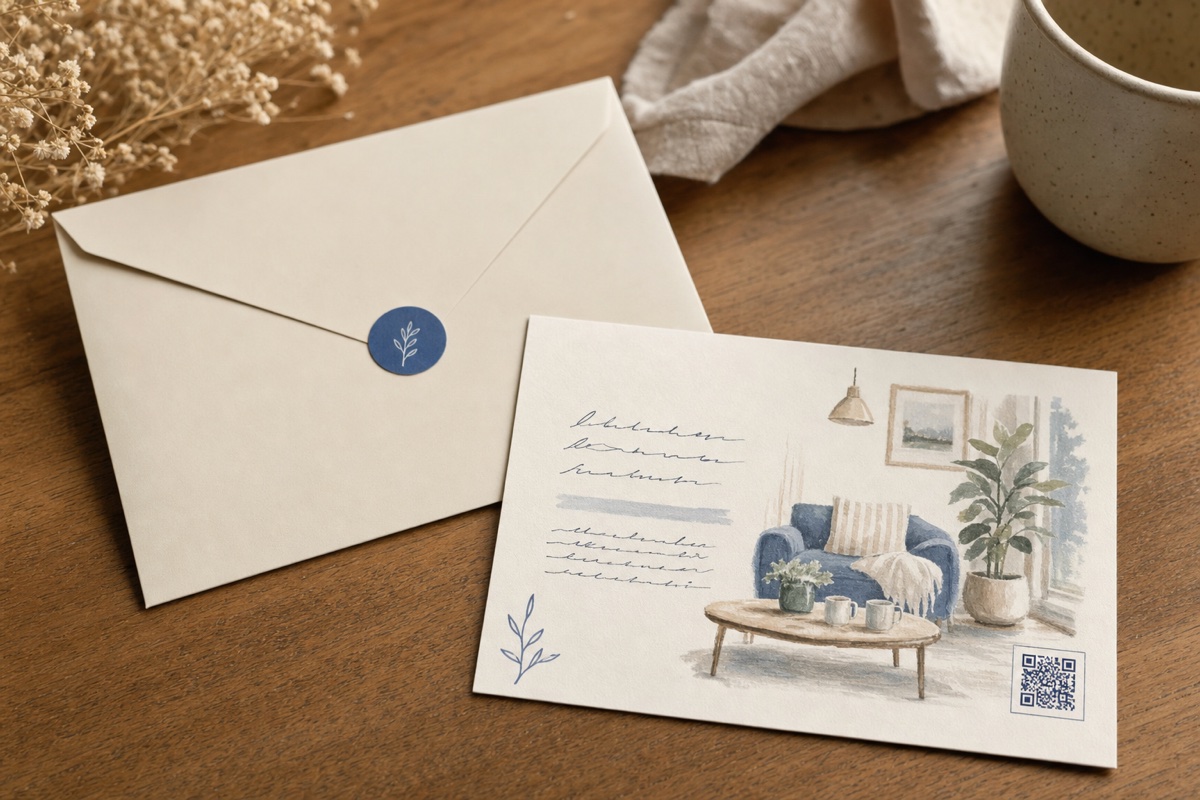
Concept rendering (AI-generated). This product does not exist yet — which is why you are free to take it.
- Format — the couple registers their neighborhood and tastes, and every Monday "exactly one indoor course for this week" arrives in the mailbox as a handwritten-feel postcard (plus a QR code to a detailed guide).
- The courses — not malls but local small-business spaces: neighborhood workshop one-day classes, independent bookstore events, board-game cafés, small exhibitions. Novelty is guaranteed every week.
- The core design — there is always exactly one option. You don't choose; you tear it open. Not an information service but a decision-making service.
- Revenue — a ₩9,900 (about $7) monthly subscription (four postcards) plus settlement with local venues "per couple whose visit is verified through the postcard's QR code," not for exposure. Performance-based, so it's light on small businesses.
The details are reverse-engineered not from taste but from the anxiety answers in the survey. "What if the recommendation doesn't fit my taste" → a light taste-and-radius setup at sign-up and a one-time trial kit first. "If the mail is late, the plan falls apart" → guaranteed Monday arrival, and the QR guide opens instantly. "If we can't go out one week, it's wasted" → the postcards have no expiry and become a collection of course cards, a record.
The runner-up was the "Weather Shelter Kit" (a couples' box for heatwave or cold-wave days, pulled out at home, monthly) — it tackles the limits of the home date (⑤) head-on, so it's worth taking too.
Now the hypothesis — "Is decision fatigue painful enough to pay ₩9,900 a month?" — gathering 100 real couples to ask would take weeks. We ask synthetic consumers first.
5. We asked 100 synthetic consumers
From a corpus of one million synthetic consumers, we searched for "people tired of searching for somewhere to go every weekend." Out of 432 candidates, 100 were confirmed — centered on ages 22–35, working couples from cooks and kindergarten teachers to data analysts and product planners. The search signal was "rich."
We ran an eight-question survey on these 100. The key results:
Pain point number one was not search time but "filtering out the ads." The most-named discomfort (a minority share) was "so much sponsored content that it's hard to pick out places that are actually good" — meaning the real nature of the search labor is not time but the cost of distrust. Next, in small shares, came "ending up back at the usual mall" and "the planning burden falling on one person."
❝The same places keep coming up, it's frustrating, so I end up going to look for videos instead.❞ — age 28, production-control clerk ❝I'm always the one looking up where to go while my husband just says anything is fine — it's tiring.❞ — age 32, married
The concept response leaned to "alongside." "Keep my current way but try it too" was about half — switching completely was a minority. With free search as the standing alternative, the signal says the right entry is to build trust alongside existing searching rather than aim for a full switch. Hesitation number one, as expected, was "what if the single recommendation doesn't fit my taste?"
And the unexpected finding — throughout the answers, it wasn't dating couples but married couples who showed up. "For us, a married couple who fight every weekend over indecision, this would be a welcome piece of mail that takes the worry away" (age 34). The customer-opinion summary also picked out a hidden customer: "a dual-income couple three years into marriage" — for them this service is not a date course but a peacekeeping device that blocks the weekend squabble. The moment the target definition widens.
6. Conclusion — price and target
Proposed price: ₩9,900 (about $7) a month (one postcard a week, four a month)
In the synthetic survey, fair-price answers leaned heavily into the ₩8,000–12,000 range (about $5.70–8.60) (shape: leaning), and nobody chose ₩15,000 or more. ₩9,900 sits at the center of the accepted range. Compared with measured market prices:
| Item | Measured price | Note |
|---|---|---|
| Weekend movie date (two people) | around ₩32,000 (about $23) | CGV weekend standard 2D (checked Aug 2026) |
| Chain café (two people) | around ₩13,000 (about $9) | an Americano, a latte, and a dessert |
| One-day class (two people, one session) | ₩60,000–100,000 (about $43–71) | workshop-class platform rates (checked Aug 2026) |
| This Week With You (proposal) | ₩9,900 a month | four weekend plans, a month's worth |
Not the cost of one date but the price of "a month of decision fatigue" — the frame of two cups of coffee holds.
Target customers:
- Couples in their 20s and 30s in the Seoul metro area, one to three years in — couples whose weekend date starts with a "where should we go?" text and whose planning burden falls on one side. The "planner" of the two is the one who pays.
- Dual-income married couples (the hidden customer) — couples for whom making a weekend plan is itself a source of conflict because weekday energy is spent. A group to approach not with "a cute couples' product" but with "a weekend-peace subscription."
The call — proceed (keep). Problem resonance and price response are solid. But unless the number-one barrier — "one course that doesn't fit my taste" — is solved, it can't beat free search. Before producing at volume, gate number one is ① validating satisfaction with the unboxing experience through a one-time trial kit with taste-and-radius setup, and ② strengthening the local-venue storytelling (what free social media can't give) in the postcard guide.
You can take this idea
"This Week With You" is not a product we will build. It is a public research sample that started from trend data and went one full lap through validation.
Written by the BizForge team, our Korean edition. We help first-time founders test ideas with synthetic consumer data — a tool that shows which way an idea fails, not one that promises success.
Disclosure — The survey in this report is an AI simulation built on a corpus of one million synthetic consumers, not real consumer research. It is for reading tendencies and direction, not precise numerical prediction. Expanding into a brokerage model may require registration as a travel or e-commerce business.
Sources
- Google Trends, South Korea, past 12 months (retrieved Aug 18, 2026) — "indoor date" trend, rising related searches
- Many indoor-date reviews on Naver blogs and Cafe forums (June–Aug 2026; quotes are paraphrased)
- Price research (Aug 18, 2026): CGV weekend standard 2D ticket price; workshop one-day-class platform rates
Run this on your own idea
This report was made with our Korean edition. On ducira the same steps run on 100 synthetic US customers: the questions they ask, the problems they confirm, who would pay, and one first customer to talk to. Free for the first run.
Survey answers are simulated reactions of synthetic personas, not real customers. Search figures are relative indexes, not absolute volumes.