TREND REPORT · Episode 10 · September 7, 2026
Home-care searches up 39% in a year — parent care is coming
Nursing-home searches in Korea spiked once and fell back, while home-visit care climbed all year. We looked at the adult children behind those searches, designed one service for them, and asked 100 synthetic consumers what they would pay.
Trend we measured
Parent-care searches in Korea (home-visit care +39% in a year)
The idea
Care Map — a 48-hour written answer for families facing a parent-care decision
Price after asking 100 consumers
₩49,000 (about $35) per report, down from a ₩99,000 hypothesis
Target customer
The adult child, often in their 50s, who ends up making the decision — plus dual-income children living far away
This is the tenth story in our series on business ideas found in search data.
In Korea, Chuseok — the harvest holiday when families go home — is three weeks away. Some people will drive back from their parents' house with a heavy heart. Dad walks slower than he used to. Mom tells the same story twice. That night they type words into a search box for the first time: nursing home, home-visit care, senior living.
This report measures those searches. And for the first time in the series, we look at a trend that has no reason to cool off.
Measure the trend → find out why people react → design an idea → check it with 100 synthetic consumers → settle on a price and a target
1. Measuring the trend: look at the floor, not the peak
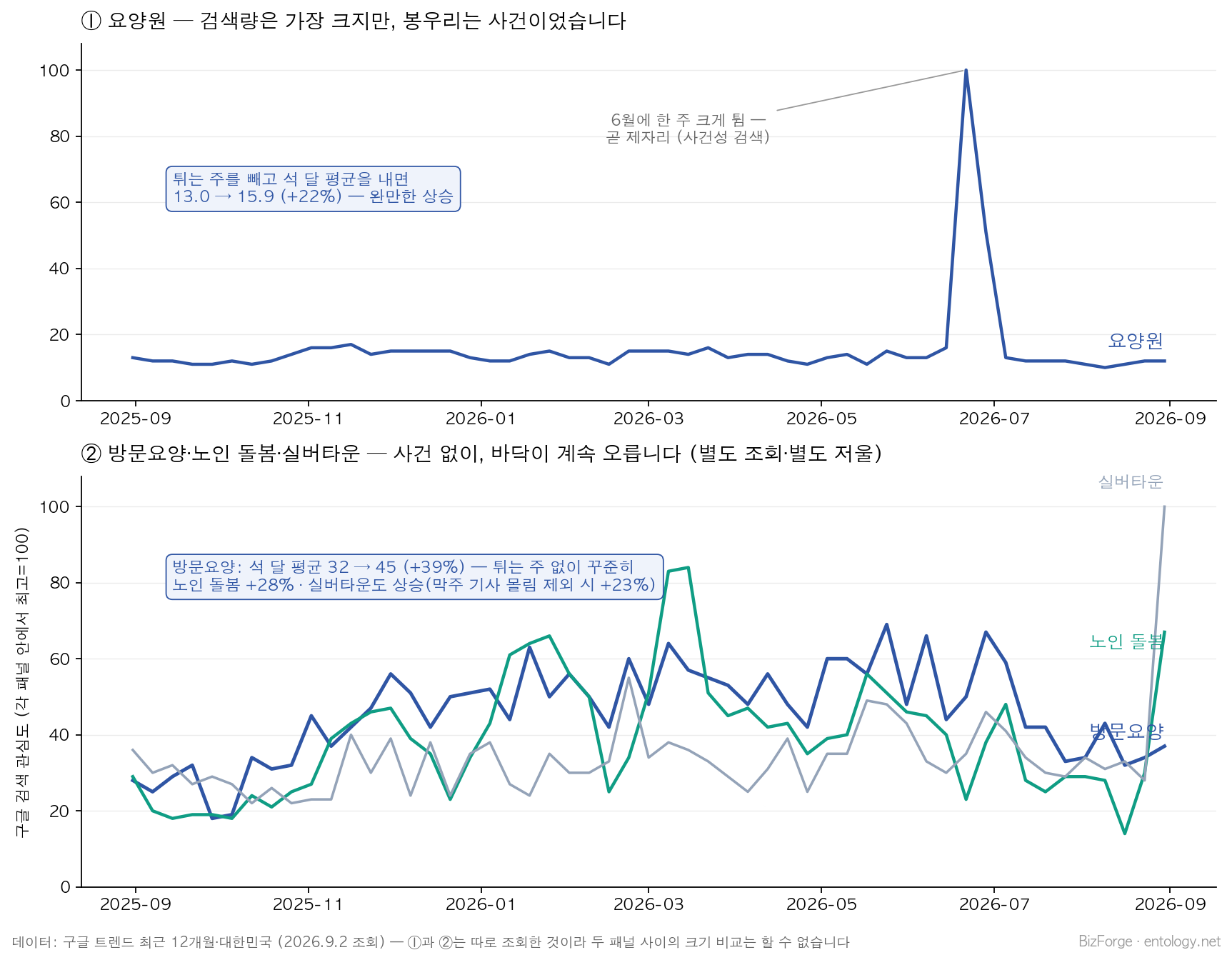
The chart is the original from the Korean report, so its labels are in Korean. Top panel: 요양원 is nursing home. Bottom panel: 방문요양 is home-visit care (blue), 노인 돌봄 is elder care (green), 실버타운 is senior living community (gray). The two panels come from separate queries, so their scales cannot be compared with each other.
We measured the last 12 months on Google Trends for Korea. The first thing that catches the eye is the June peak for nursing home — and that is not what we should look at. It is a one-week spike that fell straight back: a news-driven search. The Dubai chewy cookie in our last report taught the same lesson. A peak is an event. The evidence for a business is the floor.
That floor is quietly rising. Take out the spiky weeks and compare three-month averages:
- Home-visit care: 32 → 45, +39%. Not a single spike; it just kept climbing. The cleanest line in this report.
- Elder care: +28%, also without a spike.
- Senior living: a burst of news coverage in the final week sent it soaring, but even without that week it is up 23%.
- Nursing home: by far the largest search volume of the four (several times home-visit care on the same scale), and once you remove the event week, a gentle +22% rise.
Not one word but four words rising together. A fad would send one word flying. Here, several words climb from the floor at the same time. The news matches the numbers: Korea has only 47 senior living communities (officially "welfare housing for the elderly") — 40 in 2023, 47 in 2025, according to the Ministry of Health and Welfare — and in one industry survey, 80.5% of respondents said they would be willing to get professional advice about caring for their parents (reported September 2026).
In short, this is not a passing trend. It is demographics. And demographics do not disappear in eight months the way a cookie fad does.
2. Why people react — five real reasons behind the searches
We gathered posts on Korean forums and blogs where adult children wrote, in their own words, about facing their parents' care.
① It hits all at once — "In the end I couldn't handle it alone anymore, so I went for a consultation over the holiday." A fall, a hospital stay, a dementia diagnosis comes first; the information comes later. One of the heaviest decisions of a lifetime has to be made within days, with no preparation.
② Guilt holds the decision hostage — "It's been a week since we moved her in. Every day is tears — guilt, and feeling sorry." On a forum for families of dementia patients, a post titled roughly "Placing them in care is not abandoning them" is shared over and over. That many people need that comfort.
③ The types and the costs are a maze — What is the difference between a nursing home, a long-term care hospital, a senior living community, and home-visit care? How do you get a long-term care insurance grade? What does it really cost each month? Yet the people who did the research report a twist: "Once the care grade applied, the out-of-pocket cost was smaller than I expected — that was the surprise." What scares people most is what they do not know.
④ The parents refuse — "Even at her age she still hates any talk of senior living. But the longer she is alone, the more I worry about her meals, and as her child I can't feel at ease." The child does the worrying, but the parent holds the decision and the veto. The conversation never even opens.
⑤ They go to forums for real stories, not ads — On senior-living information forums, the introduction post has become its own genre: "I joined to look into senior living for my parents." Search results are papered with facility ads, so people go to a community to find someone who was once in their shoes.
Boil the five down to one line: what people want is an answer for our family's situation. But almost everyone giving out information today is selling something — facilities sell admission, insurers sell policies, referral agencies sell referrals. Nobody gives answers without selling. That is the empty seat.
3. An idea that fills the gap
Using the five reasons as raw material, the AI generated 12 ideas, and we picked one by asking: "Does it solve a problem that really hurts?"
Care Map
For adult children facing a parent-care decision: a one-on-one advisory service that writes up "the answer for our family" within 48 hours — and recommends no facility.

Concept rendering (AI-generated). This service does not exist yet — which is why you are free to take it.
- How it works — You send your parent's condition, your region, your budget, and your family situation. Within 48 hours you get a report: ① the type of care that fits your situation, and why ② how to apply for a long-term care insurance grade and what you will likely pay out of pocket ③ a checklist and questions for facility visits ④ how to open the conversation with your parent and your siblings.
- The core — It recommends no facility. The only money comes from the family. Neutrality has to be built into the structure, and that means no ties to anyone who sells.
- Who writes it — Qualified advisors, under their real names, with the reasoning and the sources (the official long-term care insurance criteria). It draws a clear line: this is a care decision information service, not medical diagnosis or legal advice.
- Price hypothesis — ₩99,000 (about $71) for an urgent one-time report with a 48-hour turnaround, then a ₩29,000 (about $21) monthly subscription.
The runner-up was a "72-hour care decision kit" — a physical kit handed to families right after a crisis, with the care types laid out, a cost table, and phone scripts. Because it would be distributed through hospitals and funeral-service companies, the customer is closer to a business (B2B), and our consumer panel could only half-test it, so it stayed the runner-up.
One question remains. Even in a crisis, will people pay ₩99,000 for information on paper? We ask synthetic consumers first.
4. We asked 100 synthetic consumers
Out of one million synthetic consumers, we searched for "someone facing a parent-care decision, stuck in an information maze." Of the 216 we checked, 148 had this problem — the signal was "rich." Among the final 100, people in their 50s were the largest group and most were women. Google Trends does not tell you the age of the searcher, but when we went looking for the people who have the problem, we found exactly the generation that actually takes on the caregiving.
The pain split evenly four ways: no way to tell whether a facility can really be trusted; working out what will actually go out every month; too little objective information among all the ads; and confusion over the types and procedures. The four weighed almost the same, and only one person said they had no particular difficulty.
When we asked how they cope today, this report's discovery came out.
❝I go to the hospital's billing office, ask about each thing one by one, and write the amounts down in a notebook.❞ ❝I keep a spreadsheet of each facility's pros, cons, and rating grade and compare them with my parents.❞ ❝I ask colleagues at the welfare center, comb through the ministry's website, and handle the grade application and paperwork myself.❞
Spreadsheets again. After report 8 (people organizing their skincare order in a spreadsheet), here it is once more: when nobody gives them an answer, people build their own map in notebooks and spreadsheets. A clumsy homemade tool is the strongest evidence that the problem is real.
The will to switch was clear too. Only one person said "I'll keep doing it my way, no plans to change." But more people said they would run it alongside their own legwork and their friends' advice than said they would switch completely — it is their parents, so they will not bet everything on one source.
Then the plan hit a wall on price. Our hypothesis was ₩99,000. The most common "fair price" was in the ₩30,000–50,000 range (about $21–36), with ₩50,000 to just under ₩90,000 close behind. Only a few chose ₩90,000 or more. The hesitation clustered around two worries: "it might be the same generic content as a web search," and "a written report might not capture our parents' particular situation."
The unexpected customer was a 44-year-old in a dual-income household whose mother lives alone in a rural area.
❝I don't have time on weekdays to go around hospitals and nursing homes. What I desperately need is a tailored checklist: go down on the weekend and confirm just these things.❞
For a child who lives far away, this service is not information. It is a tool that saves the weekend.
A note: these results are not a real consumer study. They are a simulation built on data from one million synthetic consumers — not the answer, but a compass that shows the direction and the objections before you meet real customers.
5. Conclusion — price and target
Proposed price: ₩49,000 (about $35) for the basic report, with in-depth consultation as a separate option.
The original ₩99,000 sat above the range people would accept. The simulation's recommendation: a ₩49,000 entry-level report, plus a full sample report published before purchase — cut the price in half, and meet worry number one ("it might be generic") head-on with the sample. Put next to real care costs:
| Item | Measured price | Note |
|---|---|---|
| Nursing home, one month (grade 3, standard room, meals included) | about ₩860,000–910,000 (about $614–650) | a family member's cost breakdown (Aug 2026) |
| Senior living community, monthly living cost | from the ₩1.5 million range (about $1,070) up to several million won | move-in Q&A (Aug 2026) |
| Care Map (revised) | ₩49,000 (about $35) per report | about 5% of one month in a nursing home — the price of getting the decision right |
In front of a decision worth hundreds of thousands to millions of won every month, a ₩49,000 map is not expensive. That is the logic. But the sample has to prove it is worth that.
The target is two groups.
- The decision-maker facing a crisis (core) — someone in their 50s who has weeks to decide after a parent's hospitalization or diagnosis; the one sibling who ends up carrying the decision. The very people holding out with notebooks and spreadsheets.
- Dual-income children living far away (the unexpected customer) — people in their 40s with parents in another region, who can only visit on weekends. What they want is not information but a checklist of "what to confirm this weekend."
The call was "adjust course." The verdict read: "The problem clearly resonates, but the ₩99,000 price and the limits of a written report are barriers. Refine the direction toward a ₩49,000 entry report with a published sample."
This is the third time the simulation has rewritten a price tag — report 5 turned a subscription into a one-time product, report 9 halved ₩4,900, and now ₩99,000 is halved. It is not that we refuse to bend on ideas we like. The 100 bend them for us, every time.
One last look at the first chart. These searches will not vanish the way the cookie did. They are the shape of a population. So there is no need to chase this market fast — there is time to build it slowly and properly.
You can take this idea
Whether it is Care Map or the 72-hour kit, the skeleton laid out today — target, positioning, price hypothesis — is yours to take and start with. An idea is a very small piece of a business. Everything else is testing and doing.
Written by the BizForge team, our Korean edition. We help first-time founders test ideas with synthetic consumer data — a tool that shows which way an idea fails, not one that promises success.
Disclosure — This report is not medical, legal, or care advice, and it recommends no specific facility. The business idea in it stays within care decision information services — not medical diagnosis, treatment, or facility placement. There is no single right form of care; whether a family chooses a facility or care at home, the choice deserves respect. The survey is an AI simulation built on a corpus of one million synthetic consumers, not real consumer research. Search indexes are relative values, not absolute search volumes.
Sources
- Google Trends, past 12 months, South Korea (retrieved Sept 2, 2026, weekly) — nursing home, home-visit care, elder care, senior living. Growth rates compare three-month averages with the spiky (event-driven) weeks removed.
- Ministry of Health and Welfare, "Status of Welfare Facilities for the Elderly" (June 2026) — 47 welfare-housing communities for the elderly (as cited by Chosun Ilbo, Sept 2, 2026). Funeral-services industry report survey, "80.5% willing to get professional advice" (eKorea News, Sept 2, 2026).
- Many posts by family caregivers on Naver Cafe forums and blogs (April–Sept 2026; quotes are paraphrased and the community names are withheld).
- Price research (Aug–Sept 2026): a family member's monthly nursing-home cost breakdown; senior living move-in Q&A. Business and facility names are withheld to avoid identifying them.
Run this on your own idea
This report was made with our Korean edition. On ducira the same steps run on 100 synthetic US customers: the questions they ask, the problems they confirm, who would pay, and one first customer to talk to. Free for the first run.
Survey answers are simulated reactions of synthetic personas, not real customers. Search figures are relative indexes, not absolute volumes.