TREND REPORT · Episode 11 · September 7, 2026
Fiber supplement searches up 53% — the business is in the first two weeks
Fiber is being called "the next protein" in the US, but people quit fiber supplements in the first two weeks. We measured the trend, designed a 28-day ramp kit, and ran it past 100 synthetic US customers on ducira. 99 of 100 have the problem, 72 of 100 would pay $29, and the founder call was to adjust course.
Trend we measured
Fiber supplements in the US — searches up 53% in a year; "fibermaxxing"; "fiber is the next protein"
The idea
Thirty — a 28-day fiber ramp kit that steps the daily dose up gradually
Price after asking 100 consumers
$29 one-time starter kit (72 of 100 would buy), down from a $39 hypothesis (37 of 100)
Target customer
Adults who quit fiber supplements over gas, bloating or texture — the first customer is a 27-year-old food server who drops any new product the moment it acts up
This is the eleventh report in our series on business ideas found in search data, and the first one measured in the United States. The first ten were made in Korea by our Korean edition. This one uses US search data, US consumer voices, and ducira's own 100 synthetic US customers — so every number about those 100 is a count of individual answers.
Here is the question we started with. For ten years, "more protein" sold everything from pasta to coffee. In 2026, US food executives and dietitians keep saying the same sentence: fiber is the next protein. The searches agree. But the reviews tell a second story: most people who try a fiber supplement quit within two weeks. That gap is where this report lives.
Measure the trend → find out why people react → design an idea → check it with 100 synthetic US customers → settle on a price and a target
The short version. US searches for fiber supplements are up 53% in a year, and the pain is real: 99 of 100 synthetic customers have it. But only 13 would pay for our fix, nobody would pay for the kit as we first designed it, and 72 of 100 crossed at $29 once we changed it. The founder call was to adjust course. The rest of this report shows the counts behind each of those sentences.
1. Measuring the trend: a rising floor, and one spike to ignore
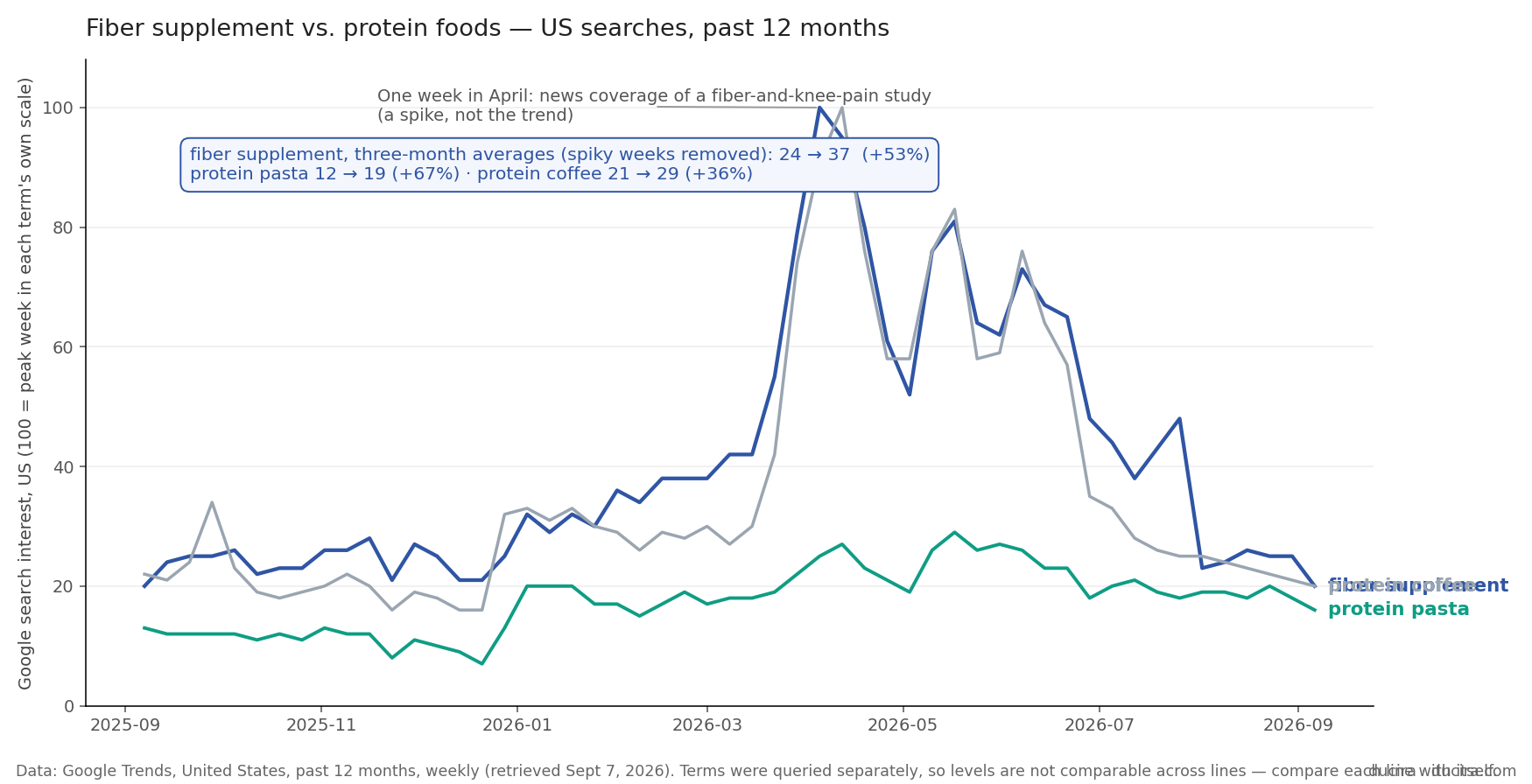
We pulled 12 months of weekly Google Trends data for the United States and compared three-month averages, leaving out the spiky weeks.
- "Fiber supplement": 24 → 37, +53%. The floor rose all year and has not come back down.
- "Protein pasta": 12 → 19, +67% — protein is still climbing in new food categories, with no spike at all.
- "Protein coffee": 21 → 29, +36%, with a jump in April when a national coffee chain put protein drinks on the menu.
The one thing you should not look at is the fiber supplement peak in the first week of April. That week, US news sites covered a British study in which a daily fiber supplement (inulin) reduced knee-arthritis pain in 117 adults. Searches doubled for a week and fell straight back. A peak is an event. The evidence for a business is the floor, and the floor is up by half.
The numbers around the searches point the same way. The Dietary Guidelines for Americans put it plainly: more than 90 percent of women and 97 percent of men do not meet the recommended fiber intake, which is about 25 grams a day for women and 38 for men, and the average adult gets 14 to 16 grams. In a 2026 consumer survey, 51% said they were increasing their fiber intake, almost the same share as those increasing protein (52%). In December 2025, PepsiCo's chief executive told analysts he thinks "fiber will be the next protein." On TikTok, the trend even has a name: fibermaxxing.
So the demand is real and growing. Then why do so many people fail at it?
2. Why people quit — five real reasons from US forums
We read what Americans wrote in their own words on Reddit, in health forums, and in product reviews. Quotes are paraphrased and the posters are not named.
① The texture is the gate — Psyllium husk, the most common supplement fiber, thickens in water. People describe it as goopy or pudding-like, say they gag on it, and share tricks: stir it into yogurt to hide the feel, add lemon juice, "down it quick before it sets." One person on a weight-loss drug wrote that they simply could not get on with the texture and switched to soaked chia seeds and magnesium instead.
② The first two weeks hurt — Gas, cramps and bloating when the dose jumps. Dietitians say to add about 5 grams a week and give the gut two to three weeks to adjust, but the tub does not come with a schedule. A common forum reply to a bloating complaint is "a sudden spike in fiber," followed by "start with a third of the serving."
③ People on GLP-1 drugs build their own routines — Constipation is on the labels of these drugs: in Wegovy's trials, 24 of 100 adults reported it (11 of 100 on placebo); in Zepbound's, 5 to 7 of 100 depending on the dose, with more in the first months. On those forums, fiber is not a lifestyle choice but a daily fix, and the routines are elaborate: psyllium first thing, then black coffee, water all day, magnesium at night, a footstool in the bathroom. One poster called constipation "the number one worst part" of the medication. A home-made routine this detailed is the strongest evidence that the problem is real — and that the current products do not solve it on their own.
④ Gummies are the easy way, and they are not enough — Fiber gummies deliver 2 to 5 grams per serving and lean on sugar alcohols. People say they "chew more than they should," read the ingredient labels closely, and still keep a backup laxative.
⑤ The number is the goal, and counting is a chore — "30 grams" is the target people repeat. Reaching it means tracking every meal, hunting for cereals with 9 grams a serving, or buying one of the new fiber-tracker apps. Some people post daily fiber tallies online the way others post step counts.
A few of the voices, paraphrased, with the forum they came from:
❝Metamucil makes me gag no matter what I mix it into. Are the pills just as good?❞ (r/Cholesterol) ❝I tried it in water once, gagged, and threw it back up. Now I hide it in my oatmeal.❞ (r/Gastroparesis) ❝Psyllium stirred into oat bran turned into slimy wallpaper paste. Straight into the trash.❞ (r/Function_Health) ❝Each particle swells to fifty times its size in water. Buy plain psyllium in bulk, start small, and work up over a month.❞ (r/askgaybros) ❝Constipation was my bane for the four weeks on the starting dose. It didn't clear until I figured out my own system: at least 100 ounces of water a day, and the rest.❞ (r/Zepbound) ❝A doctor told me to take fiber gummies. That worked for two years, then chronic constipation again. Turns out most of them are built on sugar alcohols.❞ (r/SIBO) ❝I track grams of protein and fiber and leave the rest alone: 140 of protein, 30 of fiber. Both are hard to hit.❞ (r/nutrition)
Boil the five down to one line: people do not fail at fiber because they lack fiber. They fail at the ramp — the first two weeks of texture, gas and guesswork. Powders sell grams. Gummies sell convenience. Nobody on the US shelf sells the ramp. That is the empty seat.
3. An idea that fills the gap
We wrote down twelve ideas from the five reasons — a tasteless fiber-in-your-coffee stick, a fiber "shot" in a small gel, a GLP-1 gut-routine box, a fiber water enhancer, a ramp app, high-dose gummies, fiber-first meal kits, and so on — and filtered them with four tests: Is the pain sharp? Is there an expensive workaround? Is adjacent demand proven? Will it change behavior? The survivor:
Thirty
A 28-day fiber ramp kit for people who quit every time they try. It does not sell fiber. It sells the first four weeks.
Concept rendering (AI-generated). This product does not exist yet — which is why you are free to take it.
- How it works — 28 numbered daily sachets that step the dose up gradually: about 5 grams a day in week one, rising to about 15 in week four. The blend is two tasteless, non-thickening soluble fibers (partially hydrolyzed guar gum and acacia) that dissolve clear in coffee, water or yogurt.
- The guide — one page per week: how much to drink, what to expect, and when to hold the dose for a few days instead of stepping up.
- After the ramp — a monthly refill box keeps the habit at the full dose.
- Price hypothesis — $39 for the kit, then $29 a month for refills. Sold online, direct.
- What it is not — it treats nothing and claims nothing beyond helping you reach the daily fiber amount health authorities recommend.
The runner-up was the GLP-1 gut-routine box — fiber, magnesium and electrolytes in daily packets, timed to the injection day. The pain is sharper, but a US brand already sells a fiber product aimed at GLP-1 users, and every claim in that space touches medical territory we cannot enter without proof. We kept the ramp as the main idea and, as you will see, the GLP-1 question came back on its own.
One honest note before the test: a UK gut-health brand already sells a four-week gradual fibre plan, and a US fiber brand sells a "fibermaxxing starter pack" for $39.99. So the ramp is not a new invention. What we wanted to know is whether American consumers would pay for it.
4. We asked 100 synthetic US customers
On ducira, we described the idea and the customer, and the tool searched its corpus of one million synthetic US personas for people whose lives match: nutrition-minded, digestion issues, tried and quit. Of the 1,200 closest candidates it checked, 45 clearly had the problem, so the market signal came back "moderate," not strong. It then confirmed 100 people, one by one.
Two honest notes about the 100. The corpus records jobs, habits and interests, not supplement history, so the tool adds the target condition — "tried fiber and quit" — as the premise each persona answers from. And because the search keys on nutrition interests, the sample leans toward people who already know fiber: 24 of the 100 work as dietetic technicians and 6 are dietitians. The 100 are 76 women and 24 men, median age 34, mostly in their 30s, with Texas, California and New York the most common states.
First, they asked their own questions. The 100 produced 16 distinct questions about the kit. The most common, asked by 43 of 100: since my GLP-1 shot slows my stomach, how does this blend avoid painful gas compared to other fibers? Next: does it really dissolve without thickening or changing the taste (35 of 100); will a dose increase hit me with urgency or gurgling at work or during a workout (25); what tells me to hold my dose instead of stepping up (16); can I cancel the refill easily (12); how much water do I need (12); are there spare sachets if I hold (11); why pay $39 instead of buying bulk powder (8).
Then the tool turned the questions into ten hard questions, and we answered them in the founder's voice — from here on, "I" is the founder role we played. I could refute three — the texture question (these fibers do not gel, which a free sample can prove), the hydration question (they do not work by soaking up water like psyllium), and the "secret blend" question (the exact grams will be printed on the box and the ingredient carries a low-FODMAP certification). I could not refute seven. Among them: a rigid box of exactly 28 sachets fails the moment someone has to hold a dose; a refund promise from an unknown brand is worth less than a three-dollar trial pack at the grocery store; the name says Thirty but the refill gives 15 grams in one strength; and, twice, that I have no clinical proof for people on GLP-1 drugs and cannot claim any.
From the seven, the tool named four real problems and put each one to all 100. For every problem it asked: have you had this in the last six months, what do you do about it now, and would you pay for a fix?
| Real problem | Have it | Would pay | Might pay | What they do now |
|---|---|---|---|---|
| No gradual schedule removes the unpredictable gas or urgency that makes busy people quit | 99 of 100 | 13 | 60 | schedule around work shifts (36), stop fiber completely (33), quit the moment symptoms strike (22) |
| A rigid 28-sachet box cannot adapt to real bodies that need their own pacing | 59 of 100 | 0 | 42 | cut and pace the dose themselves (28), quit supplements (16), pause or skip doses (12) |
| The kit charges a premium for bulk fiber people can measure themselves | 53 of 100 | 0 | 0 | buy bulk raw powder (27), buy cheap generics (18) |
| It markets to GLP-1 patients with no clinical proof it is safe for slowed digestion | 51 of 100 | 0 | 39 | read medical literature (18), stop or endure (16), ask their doctor (12) |
Read the first row twice. The pain is nearly universal — 99 of 100 — and the workaround is quitting. But only 13 would pay for a fix, and for the box as designed, nobody would pay at all. The idea had found a real problem and the wrong product.
Six months on, you did not buy. Why? We asked all 100 that question too. The answers grouped into six reasons: a rigid 28-day schedule does not fit an unpredictable gut (22 people); I cannot risk gas or bloating during an active shift (20); it is too expensive for generic fiber ingredients (19); there is no clinical proof it works with my GLP-1 medication (19); my budget cannot absorb wasted money (14); I already manage with cheaper alternatives and whole foods (6).
❝Thirty-nine bucks is steep when I can buy bulk guar gum online, and stepping up fiber still makes me gassy during intense beach workouts.❞ (27, fitness instructor, California) ❝My medication delays stomach emptying, so adding fiber often backs me up worse. Without clinical data, I won't risk bloating during long hospital shifts.❞ (54, registered nurse, Indiana) ❝Previous fiber powders caused terrible bloating and ended up in the trash after three days. Give me a seven-day sample for ten dollars first.❞ (38, agricultural sorter, Massachusetts)
The founder call: adjust course. ducira does not issue a verdict; the founder decides after seeing the counts. Mine was to drop the GLP-1 marketing (no proof, and 51 of 100 worried), drop the rigid 28-sachet box, cut the price toward bulk powder, and rebuild around the one thing 99 of 100 share: predictability.
5. The fixes, put back to the group
I wrote eight design answers in plain words and the tool asked the people who had each problem whether the answer solves it, partly solves it, or does not. 90 of the 100 answered.
- Take it with dinner or at bedtime for the first two weeks, and step up only on a Friday or Saturday — 24 said it solves the problem, 60 said partly, 5 said no (of 89). The most accepted fix in the run.
- Ship 35 sachets, not 28: the ramp plus seven low-dose "hold" sachets — 17 solves, 25 partly, 7 no (of 49).
- A $9 seven-day starter strip, refundable, credited toward the kit — 14 solves, 28 partly, 6 no (of 48).
- Cut the kit price to $29 and be honest that you are paying for the plan, not the powder — 11 solves, 14 partly, 23 no (of 48). Price alone did not close the "I can measure it myself" objection.
- Refills in two strengths, 10 and 15 grams — 1 solves, 18 partly, 30 no.
- A weekly text check-in instead of an app — 0 solves, 42 partly, 47 no. Too slow for a flare-up on a kitchen shift.
- Screening out GLP-1 users at checkout — 0 solves, 45 no. Every one of the 45 people on these drugs said the same thing: you turned me away. That is the cost of the honest call, counted.
We also asked the same 90 about seven concrete features. Seven extra hold sachets: 21 must-have, 69 nice-to-have, nobody would skip it. The bedtime-dosing guide: 13 must, 74 nice. The $9 starter strip: 7 must, 70 nice. A text-message refill picker: 0 must, 58 nice, 32 skip. A one-tap "gut distress" rollback alert: 57 would skip it. And a gentle low-fermentation blend for GLP-1 users: 54 called it a must-have — the highest must-have count of anything we tested, and the one feature I cannot offer without proof I do not have.
Then the price. We offered the revised kit — 35 sachets, the weekly guide, the text check-in — at four prices and asked each of the 100 whether they would buy.
| Price (one-time starter kit) | Would buy |
|---|---|
| $19 | 98 of 100 |
| $29 | 72 of 100 |
| $39 | 37 of 100 |
| $49 | 5 of 100 |
Two of the 100 would not buy at any price. Asked for the most they would pay, the middle answer was $30; 37 people landed in the twenties, 31 in the thirties, 22 in the forties. The five people who stopped at $19 all said the same thing in different words: a tight budget, "nineteen is my hard limit."
The first customer. ducira ends every run with one person from the 100 to talk to first. Here it picked a synthetic persona we will call Yasmin: 27, a food server outside restaurants, Las Cruces, New Mexico. She has all four problems, would pay, and her workaround is the one that kills products — she "stops using new products" the moment they act up. Thirteen of the 100 look like her and would pay; seventy more might. The question that opens a conversation with her, tested on 30 of the 100 and opening all 30: when you tried fiber supplements before, what physical discomfort made you stop?
A note: these results are a simulation on synthetic personas, not real consumer research. They are a rehearsal — a way to hear the objections before you spend money — and every document ends with the conditions to check with five real customers.
6. Conclusion — price, target, and the call
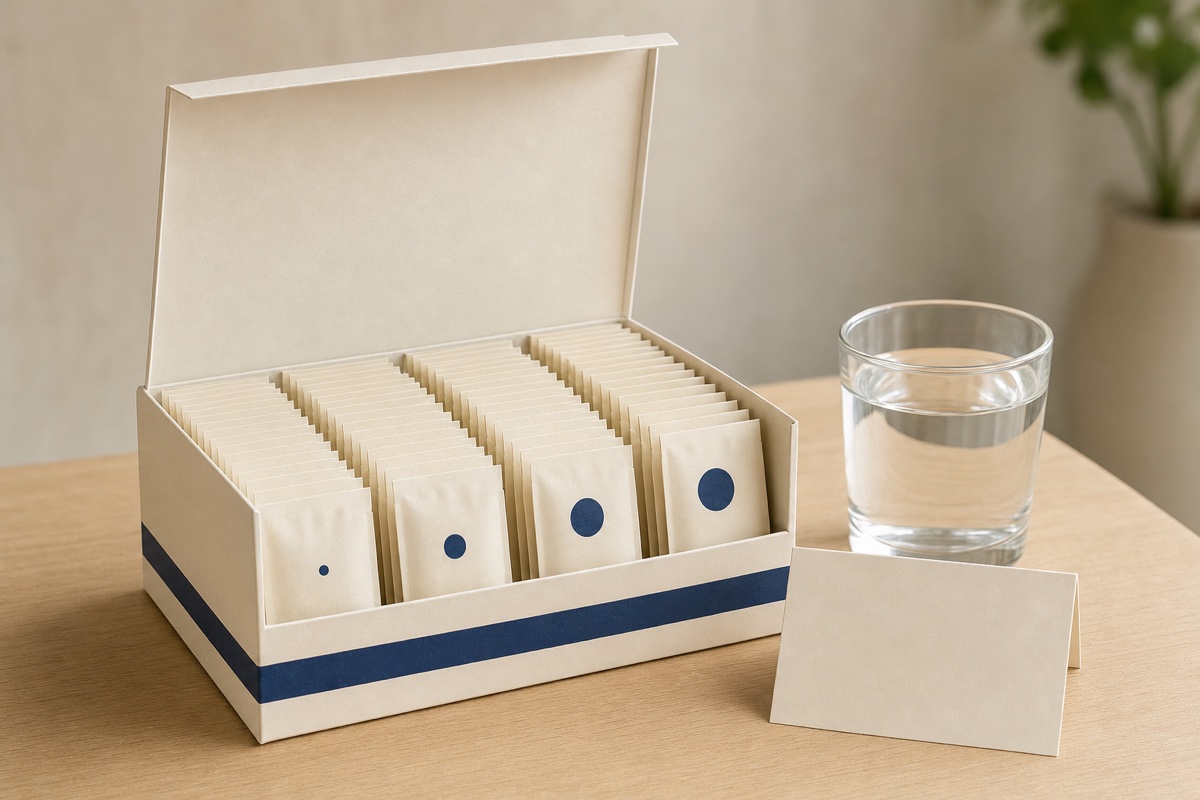
Concept rendering (AI-generated) of the revised kit. This product does not exist yet — which is why you are free to take it.
Proposed price: $29 for the 35-sachet starter kit, then $24 a month for refills. 72 of 100 would buy at $29, 37 at $39. The original $39 sat above the range. Next to real US shelf prices (checked Sept 7, 2026):
| Item | Price | Per day |
|---|---|---|
| Metamucil psyllium powder, 114 servings (Walmart) | $27.98 | about $0.25 |
| Metamucil On-the-Go stick packs, 44 (list) | $22.99 | about $0.52 |
| Olly fiber gummies, 50 (2 gummies = 5 g) | $19.82 | about $0.79 |
| Bellway psyllium powder, 60 servings (Walmart) | $17.98 | about $0.30 |
| just better. "Fibermaxxing Starter Pack" (48 servings) | $39.99 | about $0.83 |
| SoWell GLP-1 Fiber, 14 stick packs | $34.99 | about $2.50 |
| Seed DS-01 synbiotic (adjacent daily gut ritual) | $49.99 a month | about $1.67 |
| Thirty starter kit (revised), 35 sachets | $29 | about $0.83 |
The logic: per sachet, Thirty costs the same as a fiber gummy and three times a scoop of Metamucil. What the extra pays for is the plan — the ramp, the hold rule, and the check-ins — which is exactly what 53 of 100 said they would not pay for. The $29 price is where the count says most people cross anyway.
Target — one core group, and one I am walking away from.
- People with public, physical jobs who quit fiber when it acted up at work — food servers, nurses, fitness instructors, cashiers. Their question is not "how many grams" but "will this embarrass me on shift." Bedtime dosing and weekend step-ups speak to them; 84 of 89 said that fix at least partly solves their problem.
- People on GLP-1 medications (not served in version one) — 51 of 100 raised the safety question, 54 of 90 called a GLP-1 blend a must-have, and 45 of 45 rejected being screened out. They are the most motivated customers in the run and the one group I cannot serve without clinical evidence. That is a business for someone with a medical partner, not a first product for a solo founder.
The call was "adjust course," and the run wrote the conditions for the next step:
- Kill conditions — if more than 30% of the first 30 kit buyers ask for a refund citing gut distress, stop; if fewer than 40% of the first 50 answer the weekly check-in text by week four, the guided ramp does not work as designed; if fewer than 20% of the first 50 convert from the kit to a refill, the refill model is dead.
- Tripwires — at least 3 of the first 5 customers confirm they took the sachet with dinner or at bedtime in their first three days; at least 2 of the first 5 use a hold sachet instead of quitting; at least 2 of the first 5 starter-strip buyers upgrade to the full kit; at least 2 of the first 5 people offered $29 pay it — otherwise the price drops to $19.
This is the eleventh report in the series and the third time a price was cut by the customers before anyone built anything. In Korea, the 100 halved a ₩4,900 subscription and a ₩99,000 report. In the US, they cut $39 to $29 — and told the founder to leave 51 of them alone.
You can take this idea
Thirty is not a product we will build. It is a public research sample: a trend from US search data, taken through ducira's steps once, with every count left in. The skeleton — the ramp, the hold sachets, bedtime dosing, the $9 strip, the $29 price, the kill conditions — is yours to take and start with. An idea is a very small piece of a business. Everything else is testing and doing.
Written by the ducira team.
Disclosure — This report is not medical or nutrition advice and does not recommend any supplement or dose. Anyone taking a GLP-1 medication, or with a digestive condition, should ask their doctor before adding fiber. The 100 customers are synthetic personas, and everything they said is a simulation; the report is a rehearsal for talking to real customers, not a substitute. Search figures are relative indexes, not absolute search volumes.
Sources
- Google Trends, United States, past 12 months, weekly (retrieved Sept 7, 2026) — fiber supplement, protein pasta, protein coffee. Growth rates compare three-month averages with the spiky weeks removed. Terms were queried separately, so levels are not comparable across lines.
- US Department of Agriculture and Department of Health and Human Services, Dietary Guidelines for Americans, 2020–2025 — "more than 90 percent of women and 97 percent of men do not meet recommended intakes for dietary fiber"; recommended amounts about 25 g (women) and 38 g (men) a day; average intake 14–16 g.
- FDA prescribing information: Wegovy (semaglutide), constipation 24% vs. 11% placebo in adult trials; Zepbound (tirzepatide), constipation 5.4–7.2% vs. 1.4–2.8% placebo across doses.
- CNBC, "'The next protein': Fiber is shaping up to be the latest grocery obsession" (Dec 12, 2025) and CNN Business (Jan 25, 2026) — PepsiCo CEO remarks; Penn State Extension, "Food Trends 2026" and Supermarket Perimeter (2026) — 51% of consumers increasing fiber vs. 52% protein. TIME, "What Fibermaxxing Gets Wrong About Fiber" (Mar 25, 2026); Forbes, "The 'Fibermaxxing' TikTok Trend" (May 3, 2026).
- University of Nottingham, INSPIRE trial (Nutrients, 2026; news coverage Mar–Apr 2026) — daily inulin supplement and knee osteoarthritis pain in 117 adults; the source of the April search spike.
- Reddit posts and comments (2025–2026) via a public archive — r/Cholesterol, r/Gastroparesis, r/Function_Health, r/askgaybros, r/Zepbound, r/mounjarouk, r/WegovyWeightLoss, r/SIBO, r/nutrition and others — on psyllium texture, fiber bloating, GLP-1 constipation routines, fiber gummies and fiber tracking; quotes are paraphrased and posters are not named.
- Prices (Sept 7, 2026): Walmart, Amazon, Sam's Club and brand sites for Metamucil, Olly, Bellway, just better., SoWell and Seed; the UK gradual-ramp fibre plan is The Gut Tailor.
Run this on your own idea
This report was made with the same steps you get on ducira: 100 synthetic US customers, the questions they ask, the problems they confirm, who would pay, and one first customer to talk to. Free for the first run.
Survey answers are simulated reactions of synthetic personas, not real customers. Search figures are relative indexes, not absolute volumes.