TREND REPORT · Episode 5 · September 7, 2026
"Can my dog eat peach?" searches tripled — a "just one bite" business
In Korea, searches for "dog peach" tripled while "dog treats" cooled. We designed an NFC fridge card that answers "can my dog eat this?" in three seconds — and 100 synthetic consumers rewrote the business model from a subscription to a one-time kit.
Trend we measured
"Can my dog eat peach?" in Korea — 3x the searches, while "dog treats" cooled
The idea
Before One Bite — a fridge NFC card that answers "can my dog eat this, how much, how to prep it" in three seconds
Price after asking 100 consumers
₩9,900 (about $7) one-time starter kit with a vet-reviewed mark; subscription only after testing
Target customer
Data-minded dog owners who weigh every gram, and safety-first first-time owners
There is a scene that repeats every summer. You are peeling a peach, and at your feet a pair of eyes and a sniffing nose.
"Can I give him a slice?"
This question exploded on Google in Korea this summer. Searches for "dog peach" tripled from last year, and "can dogs eat peaches" rose in the 16,000-percent range. Plums, watermelon, melon, corn — the same question repeats with every seasonal food. This week we dug into those eyes.
Measure the trend → find out why people search → translate it into needs and wants → an idea that solves them → check with synthetic consumers → settle on a price and a target
1. Measuring the trend: treat searches cool, "can they eat it?" heats up
We overlaid the two terms on Google Trends (South Korea, past 12 months; relative index, peak in the period = 100).
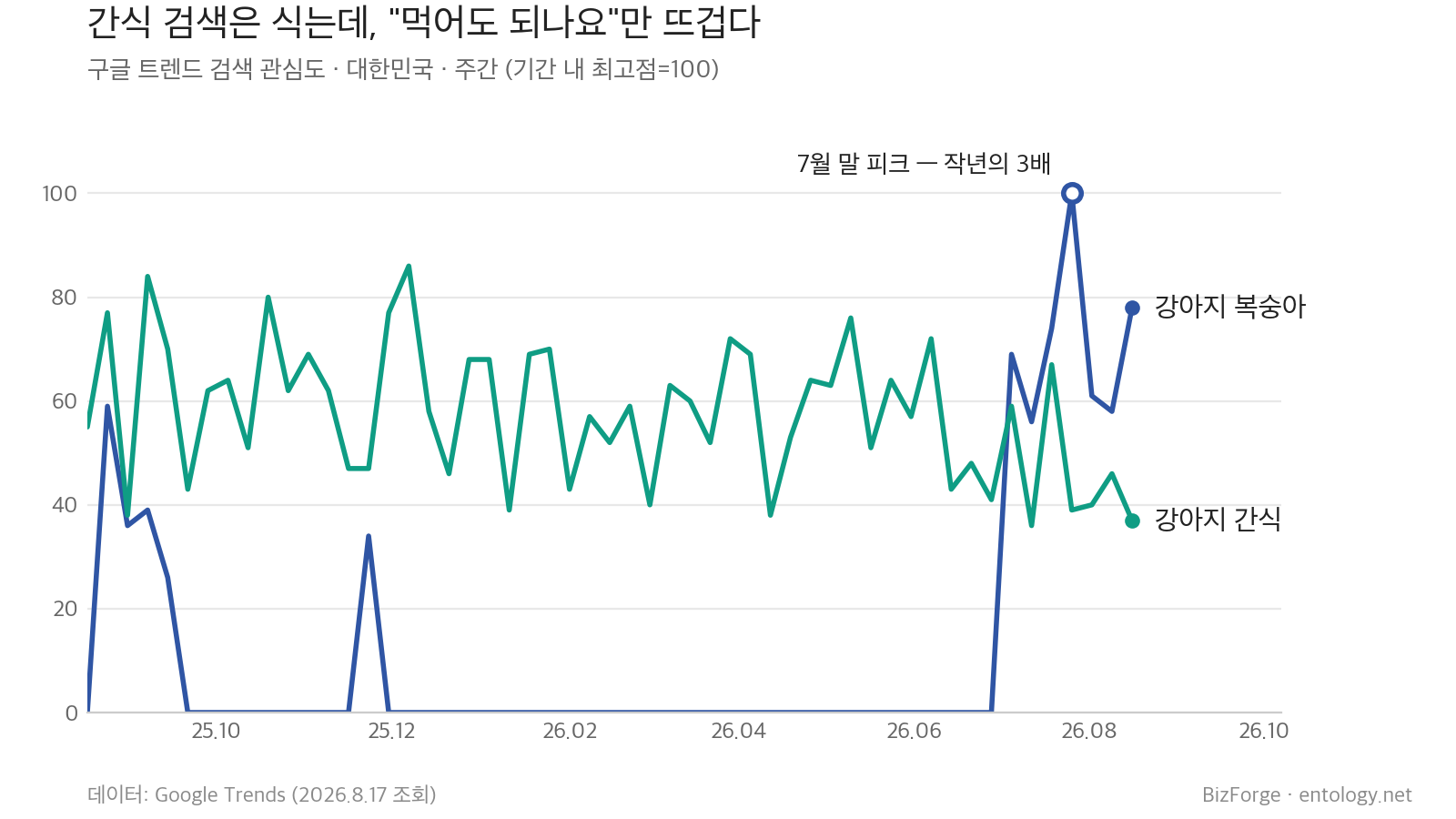
The chart is the original from the Korean report, so its labels are in Korean: 강아지 복숭아 is "dog peach" and 강아지 간식 is "dog treats."
- Dog peach: quarterly average 12 → 38, triple last year — a peak of 100 in late July, still 58–78 in August
- Dog treats: 63 → 50 — the big market is, if anything, in gentle decline
This contrast is the point. The manufactured category "treats" has matured, while the behavior of sharing human food is exploding. The front line of treating pets as family (pet humanization) is "eating what I eat, together." One note: Google Trends does not reveal age or gender — later on, the synthetic consumer data fills that in.
2. Why do they search? — five real reasons found in reviews
We gathered what dog owners said in their own words in feeding reviews on Naver blogs.
① The "just one bite" moment — "I was peeling a peach and saw Mongsil sniffing next to me, and I looked up all sorts of things wondering if I could give him a slice." Every moment of wanting to share starts a search.
② Fear of pits and skins — The body of every feeding post is a warning. The toxic compounds in seeds, the skin, the leaves. They know a mistake means the emergency room, so without certainty they just don't give any. And the dog sulks.
③ Re-searching by variety — "White peach, yellow peach, Shinbi, nectarine" — the same peach, but the answer changes by variety and firmness, so they search again.
④ Calculating the portion — "Complete guide to feeding amounts" content has become a genre. The burden of estimating the right amount for your own dog's weight every time.
⑤ The seasons repeat — When summer peaches end come autumn persimmons, then winter tangerines. Every season, the same homework with a new fruit.
Put through BizForge's four-forces analysis (what pushes people to change, what pulls them, and the anxiety and habit that hold them back): the push is "the hassle of searching with wet hands every time, and inaccurate information," and the pull is "the reassurance of tapping a phone on a fridge card and being done in three seconds." On the other side stand anxiety ("would I pay monthly and use it often?") and habit ("open Naver as always, or eyeball it") — and that anxiety produces this report's twist.
3. Translating into needs and wants
To turn reasons into business material, they have to be translated into "the job these people are trying to get done." Three layers came out of the analysis.
- Functional need — "Check the safe prep and the portion on the spot." Immediacy is the essence. (①③④)
- Emotional want — "Grow the joy of sharing food, and ease the anxiety about doing harm." (②)
- Social need — "Live as a responsible owner who cares attentively." (⑤)
Lay today's products over these three layers:
| Function (check on the spot) | Emotion (less anxiety) | Social (a responsible owner) | |
|---|---|---|---|
| Web search and blogs | ✕ reassembling the answer among ads every time | ✕ every post says something different — more anxiety | △ |
| Vet consultation apps | △ paid per case, waiting | ○ | ○ |
| Store-bought pet treats | ○ no thinking needed | △ | ✕ not the joy of "sharing mine" |
| The empty seat | ○ | ○ | ○ |
4. An idea that fills the gap
We ran an AI divergence-and-convergence pass with the five needs and wants as seeds. High-temperature models produced 10 candidates, and a judge model filtered them with four tests for latent demand (Is the pain sharp? Is there an expensive workaround? Is adjacent demand proven? Will it change behavior?). The survivor:
Before One Bite
At the very moment you are peeling the fruit, tap your phone and the answer appears in three seconds. A fridge-mounted NFC card plus seasonal feeding alerts.
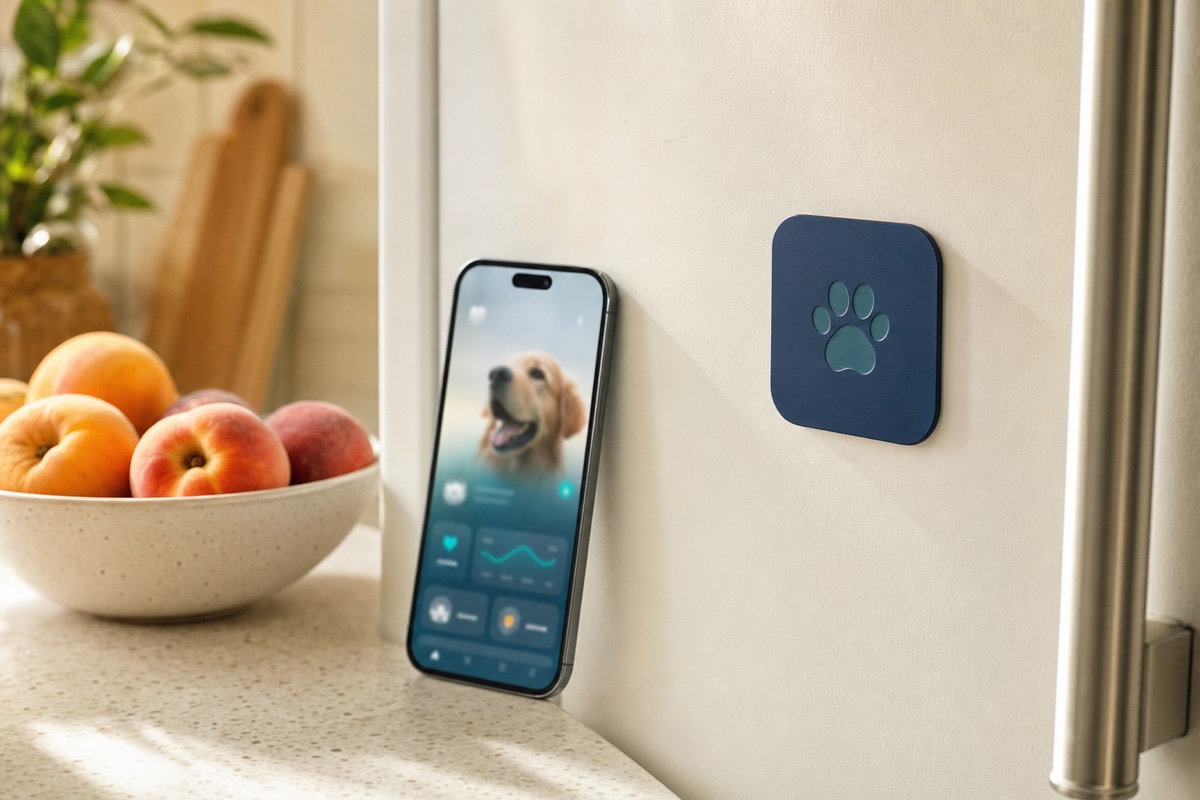
Concept rendering (AI-generated). This product does not exist yet — which is why you are free to take it.
- Form — a small card that sticks to the fridge. Register your dog's weight and age once, and the moment you tap your phone it shows "this fruit — can they have it, how much, and how to prep it."
- Tailored — not a generic feeding table but your dog's standard. Down to the variety and the state (firm or soft).
- Seasonal rotation — when peaches end, persimmons and tangerines follow, with weekly seasonal alerts. So you don't study again every season.
- Execution — a no-code MVP is possible (card encoding plus a web app), with minimal manufacturing and inventory risk. As an information service it is not subject to feed-law registration, and it states up front that it is not veterinary diagnosis or treatment advice.
The runner-up was "Fruit Day" — a subscription of seasonal fresh-fruit kits, pits and skins removed and portioned by weight, delivered overnight. A strong direction that takes on the prep work too, but portioning fresh fruit comes with heavy gates: feed-law registration, cold chain, and spoilage rates. If you take it, start small in one region and get the unit economics first.
Now the hypothesis — "Once you know, isn't that the end? Will people pay every month?" — we ask synthetic consumers first.
5. We asked 100 synthetic consumers
From a corpus of one million synthetic consumers, we searched for "owners for whom the safety check is a burden when sharing human food." Out of 1,200 candidates, 100 were confirmed — and this time the ages were interesting. They ran from teenagers to people in their 70s, median age 42, mostly women but a third men. The breadth of the pet-owning population shows through. The search signal was "rich."
The key results of the eight-question survey:
Pain point number one was neither the prep nor the math — it was trust. "Every blog says something different about whether they can eat it, so it's hard to trust any of it" was named the biggest discomfort.
❝Every blog says something different and there are so many ads that I honestly don't know whose word to trust.❞ ❝Our dog is family too, and I'm so nervous the pits or the skin will upset him that I prep everything myself, very carefully.❞
Strong agreement on the instant NFC check — "When I'm prepping and suddenly wonder if I need to take the pit out, tapping my phone and checking right there would be so convenient." Intent to switch completely was high too, at about half.
But — for the first time in this series, the market rewrote the business model. The response to a monthly subscription (₩2,900, about $2) was cold. Accepted prices gathered in the ₩5,000–15,000 range (about $3.60–11), and above that there was practically nothing. Hesitation number one was "hard to be sure of the veterinary expertise and trustworthiness." Put together: "not a subscription — sell a physical kit with a vet-verified mark for around ₩10,000 (about $7)" was the answer of the 100 synthetic consumers.
The unexpected finding: the most urgent voice came from owners of dogs with chronic conditions. "Even one slice of apple worries me because of the potassium or the sugar, so every time I weigh it to 0.1 g and dig through nutrition tables." What is a convenience for ordinary owners is a necessity for them. A premium niche — managing therapeutic diets — is open.
A note: BizForge results are not real consumer research. They are a simulation built on data from one million synthetic consumers — not the answer, but a compass that shows the direction and the objections before you meet real customers.
6. Conclusion card: price and target
Proposed price — a ₩9,900 (about $7) one-time starter kit, vet-reviewed mark required; subscription only after testing. The original hypothesis was "a ₩9,900 kit plus a ₩2,900 monthly subscription," but reflecting the survey's accepted range (₩5,000–15,000) and the trust barrier, we retreat to one-time sales. The subscription (seasonal alerts) gets re-tested with real usage data from kit buyers. When a hypothesis loses to the data, losing is the right outcome.
Side by side with real retail prices (checked Aug 17, 2026):
| Item | Measured price | Where it sits |
|---|---|---|
| Web search | free | Free, but every post says something different, so the anxiety stays |
| Remote vet consultation | thousands to tens of thousands of won per case | Certain, but too heavy to use at every "just one bite" moment |
| Store-bought pet treats (dried fruit chips and the like) | ₩3,000–4,000 (about $2.10–2.90) per pack | No thinking needed, but not the joy of "sharing mine" |
| Before One Bite (our proposal) | ₩9,900 one-time kit | Three seconds, on the spot, certainty by your own dog's standard |
Target customers — two kinds of people who buy trust.
- Data-minded owners who track everything (core) — grams by body weight, exact standards. Remaining worry: is the information from an unclear source? Approach: make vet review plus cited sources the face of the product.
- Safety-first first-time owners (expansion) — avoiding pits and dangerous parts comes first. Remaining worry: is an NFC tag unfamiliar? Approach: a three-second "tap your phone and you're done" demo video.
The hidden premium niche is owners of dogs with health conditions — it opens with the language of "0.1 g of anxiety." Channels, following the response pattern: the Naver portal and dog-owner Cafe forums (not Google!) — the search term grew on Google, but the community lives on Naver.
The call — the problem is real (signal "rich," switching intent about half), but this is the report where the original business model (a subscription) was rejected. So the call is "go straight to a subscription business": cautious; "pre-sell a vet-reviewed one-time kit → re-test the subscription with real usage data": worth watching. Trend research sometimes saves an idea — and sometimes, like this, it fixes the business model.
You can take this idea
Whether it is Before One Bite or Fruit Day, the skeleton laid out today — target, positioning, price hypothesis — is yours to take and start with. An idea is a very small piece of a business. Everything else is testing and doing.
Written by the BizForge team, our Korean edition. We help first-time founders test ideas with synthetic consumer data — a tool that shows which way an idea fails, not one that promises success.
Disclosure — This report is not veterinary diagnosis or treatment information; talk to your vet about what to feed your pet. Among the business ideas, making and selling physical treats is subject to registration under Korea's feed-control law.
Sources
- Google Trends, South Korea, past 12 months (retrieved Aug 17, 2026) — "dog peach" and "dog treats" search trends, rising related searches
- Many dog fruit-feeding reviews on Naver blogs (June–Aug 2026; quotes are paraphrased)
- Price research (Aug 17, 2026): remote vet consultation — typical prices on major apps; dried pet treats — typical online-mall prices
Run this on your own idea
This report was made with our Korean edition. On ducira the same steps run on 100 synthetic US customers: the questions they ask, the problems they confirm, who would pay, and one first customer to talk to. Free for the first run.
Survey answers are simulated reactions of synthetic personas, not real customers. Search figures are relative indexes, not absolute volumes.