TREND REPORT · Episode 3 · September 7, 2026
The creatine boom, poured into morning coffee
Creatine reached Korea's dollar stores and searches grew 1.7x in a year. Price is solved; the gaps left are measuring, washing, and forgetting. We designed a coffee stick with 3 g of creatine in it and asked 100 synthetic consumers what they would pay.
Trend we measured
Creatine supplements going mainstream in Korea (searches 1.7x in a year, now sold at Daiso)
The idea
Morningtin Coffee Stick — black coffee with an exact 3 g of creatine, 30 sticks a month
Price after asking 100 consumers
₩22,000 (about $16) a month, first month ₩18,900 (about $14)
Target customer
Office workers who hate washing shakers, and knowledge workers who keep forgetting the routine
Creatine has landed at Daiso, Korea's dollar-store chain. The ₩5,000 (about $3.60) tubs sold out, and reviews appeared saying "finally managed to buy one."
When a workout supplement that used to belong to gym veterans shows up in a nationwide budget store, the market has entered its mainstream phase. This week we dug into that search term.
Measure the trend → find out why people search → translate it into needs and wants → an idea that solves them → check with synthetic consumers → settle on a price and a target
1. Measuring the trend: creatine follows the road protein built
We overlaid the two terms on Google Trends (South Korea, past 12 months; relative index, peak in the period = 100).
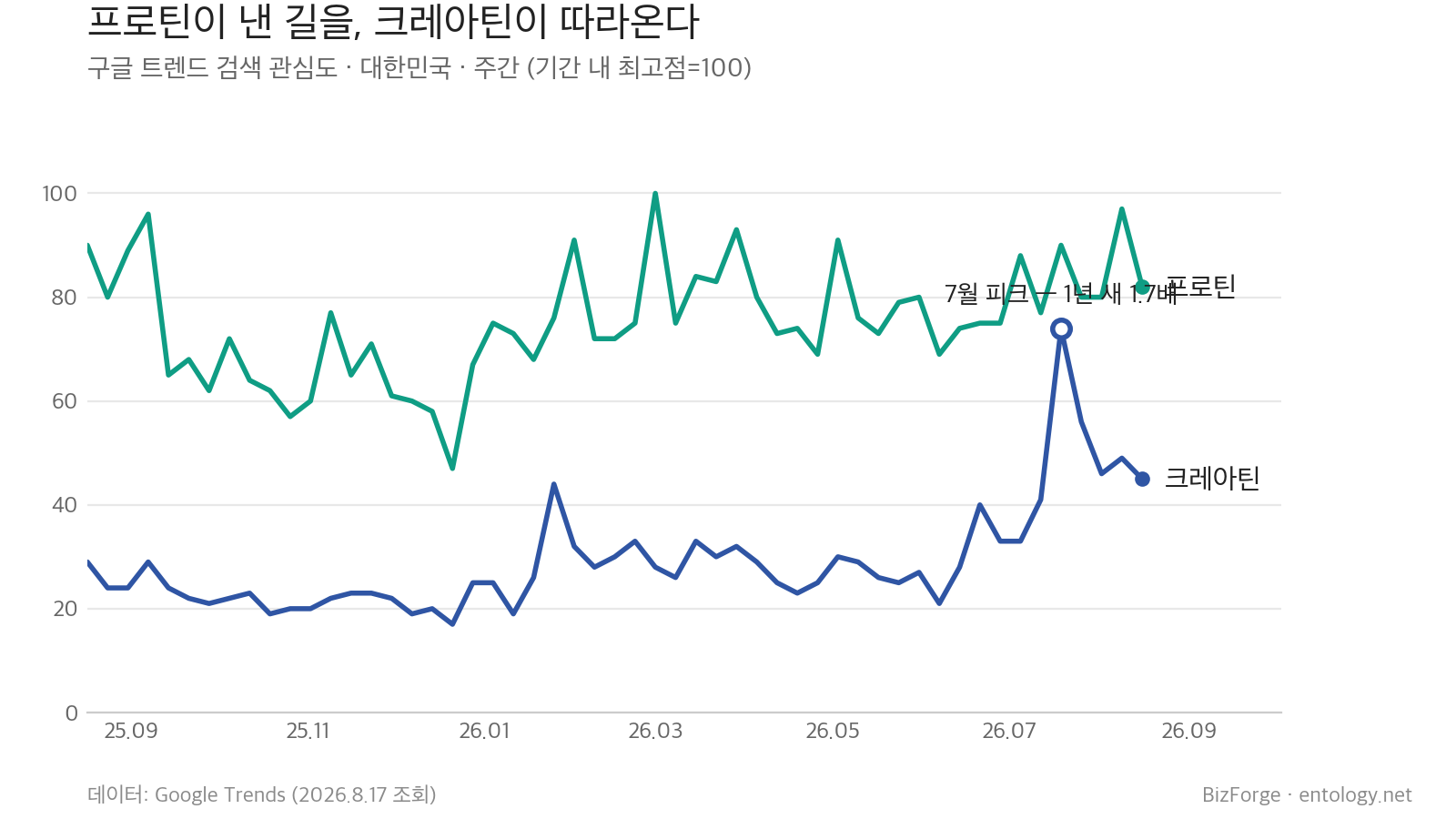
The chart is the original from the Korean report, so its labels are in Korean: 크레아틴 is creatine and 프로틴 is protein.
- Creatine: quarterly average 23 → 40, 1.7x in a year. A mid-July peak, and still flying high.
- Protein: 72 → 80 — the gentle climb of a market that has already grown as big as it will.
The picture is creatine racing down the road to mass adoption that protein walked over ten years. The rising related searches show the phase more precisely.
- "Daiso creatine" (+300%) — ₩5,000, a sold-out frenzy. The symbol of going mainstream
- "Jambaegi" (+300%) — the rise of a budget brand
- "Creapure" (+100%) — people are starting to search for the raw-material name, which means they are starting to judge quality
And the top related searches are full of worry: side effects, face (puffiness), hair loss, blood levels (confused with creatinine on a health checkup). Number one was "creatine DC" — DC Inside is a big Korean online forum, so when a question comes up, people run to the community. One note: Google Trends does not reveal age or gender — later on, the synthetic consumer data fills that in.
2. Why do they search? — five real reasons found in reviews
We gathered what consumers said in their own words in creatine reviews on Naver blogs and Cafe forums.
① Beginner information anxiety — Content like "can a woman who doesn't work out take it too?" shows how wide the beginner group has become, but the only trustworthy starter guides live in the veteran gym community (DC Inside).
② Fear of myths and misunderstandings — A puffy face, the hair-loss rumor, "couldn't sleep after taking it," worry that creatinine will read high on a checkup. People lurk on DC and Cafe forums to check their worries.
③ The pressure of a daily routine — Creatine is all about consistency, and people keep forgetting. "The routine of stirring it into my morning coffee — that's the one I never forget," one review said. People are already inventing workarounds on their own.
④ Friction of form and measuring — Powder means measuring with a spoon and washing a shaker ("I can't stand the smell that sets in"), plus a 1.2 kg bulk tub. Pills are 500 mg each, so six to ten a day. Even "having to drink a lot of water is a hassle."
⑤ A trust gap in the cheap mainstream — Daiso at ₩5,000, Jambaegi, Costco… the cheaper it gets, the more "what do I trust when I choose?" becomes the new standard. In this market, "something I can take without worrying" ranks first among the pluses people name in reviews.
Put through BizForge's four-forces analysis (what pushes people to change, what pulls them, and the anxiety and habit that hold them back): the push is "the maddening hassle of measuring an exact dose with a spoon and washing a shaker," and the pull is "the convenience of one stick, with even the rinsing gone." On the other side stand anxiety ("it might ruin the taste of my coffee; a recurring charge is a burden") and habit ("the takeout coffee in front of the office, and putting it off").
3. Translating into needs and wants
To turn reasons into business material, they have to be translated into "the job these people are trying to get done." Three layers came out of the analysis.
- Functional need — "Get the exact dose without annoying tools." No measuring spoon, no shaker, no water bottle. (④)
- Emotional want — "The satisfaction and reassurance of having completed the routine." The opposite of the anxiety that forgetting resets the effect. (②③)
- Social need — "Being seen as someone who takes care of themselves with style." The opposite of a 1.2 kg protein tub on the office desk. (①⑤)
Lay today's products over these three layers:
| Function (exact dose, no tools) | Emotion (reassurance, no forgetting) | Social (stylish self-care) | |
|---|---|---|---|
| Budget powder (Daiso, Jambaegi) | ✕ measuring and washing friction unchanged | ✕ forgetting unchanged | △ the clunkiness of a bulk tub |
| Pills and capsules | △ six to ten a day | △ | △ |
| The empty seat | ○ | ○ | ○ |
Daiso has pushed price all the way down. The gaps that remain are friction and forgetting — and consumers have already dropped a hint of the answer: "stirring it into coffee is the one I never forget."
4. An idea that fills the gap
We ran an AI divergence-and-convergence pass with the five needs and wants as seeds. High-temperature models produced 11 candidates, and a judge model filtered them with four tests for latent demand (Is the pain sharp? Is there an expensive workaround? Is adjacent demand proven? Will it change behavior?). The survivor:
Morningtin Coffee Stick
Put an exact 3 g of creatine into the morning coffee you already drink every day. The workaround people invented for themselves, finished as a product.
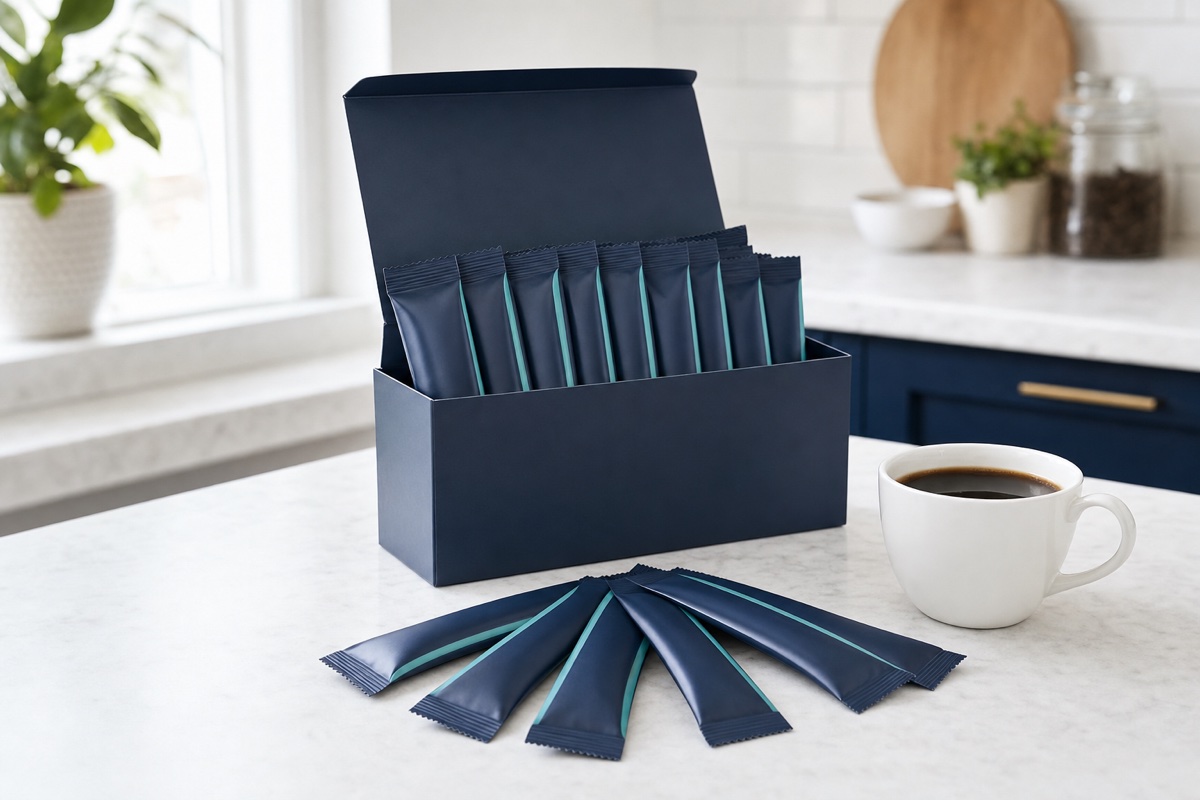
Concept rendering (AI-generated). This product does not exist yet — which is why you are free to take it.
- Form — an all-in-one stick of black coffee plus 3 g of creatine, 30 sticks a month by subscription. Tear, pour, done.
- Ingredients — tasteless, odorless creatine (Creapure grade) with the lab test report published in full. The answer to "what do I trust when I choose?"
- Respecting taste — for people set in their coffee ways, an option to mix tasteless "creatine only, no coffee" sticks into the same box.
- Storage — room-temperature sticks. No tub, no spoon, no shaker, no dishes.
The details are reverse-engineered from the hesitations in the survey. "It might spoil the coffee's flavor" → a tasteless ingredient, black by default, the plain-stick mix. "I can't trust the ingredient" → the published test report. "A subscription is a burden" → a trial price for the first month. Note: this is an ordinary food; efficacy claims (muscle growth, athletic performance) cannot be made, and we do not make them.
The runner-up was "Clear Label" — a B2B idea that turns the seven most common misunderstandings (puffiness, hair loss, the creatinine mix-up and so on) into a set of verified content and licenses it to small supplement brands. A good direction, but the buyer is a brand manager, not a consumer, so instead of our consumer survey it needs to be tested with manager interviews. If you take it, go in that order.
Now the hypothesis — "If it rides on coffee, will the routine hold, and will people pay ₩20,000 (about $14) a month?" — we ask synthetic consumers first.
5. We asked 100 synthetic consumers
From a corpus of one million synthetic consumers, we searched for "people whose supplement routine collapses over measuring, washing, and forgetting." Out of 826 candidates, 100 were confirmed — mostly in their 20s and 30s, roughly 6:4 men to women, from fitness instructors to researchers and developers. The search signal was "rich" — the densest of the three reports in the series so far.
The key results of the eight-question survey:
The pain spread evenly four ways. Washing the shaker, forgetting the timing, measuring with a spoon, carrying the tub — not one of them but all of them, each nibbling away at the routine.
❝I really can't stand the smell that sets into the shaker, so I wash it thoroughly the moment I get home from work every day.❞ ❝My lab schedule is so tight that keeping the routine without an alarm is really hard.❞
And for the first time in this series, the response was not "split" but "leaning." "Stop what I do now and switch completely" was about half, and "no plans to change" was rare. We worried that combining it with coffee would feel like an intrusion on taste, but the enthusiasm for "freedom from dishes" far outweighed any resistance.
❝Every morning it was a job to move each of my supplements over one by one, but with this you just tear open one stick.❞
The hesitation scattered five ways — spoiling the coffee flavor, the subscription price, trust in the ingredient, "taking it separately is enough," and caffeine control. Not one big wall but several low steps, and each becomes a product design to-do.
The unexpected finding: the most urgent voice split not by workout intensity but by occupation. A synthetic persona of an IT developer answered, "Without coffee in the morning I can't code, and washing the shaker and scooping powder every day was the biggest chore." What this product sells may not be creatine but bringing morning chores down to zero — a signal that the market widens to high-intensity knowledge workers in labs and offices in general.
A note: BizForge results are not real consumer research. They are a simulation built on data from one million synthetic consumers — not the answer, but a compass that shows the direction and the objections before you meet real customers.
6. Conclusion card: price and target
Proposed price — a ₩22,000 (about $16) monthly subscription, first month ₩18,900 (about $14). Acceptance in the synthetic survey gathered about half in the ₩20,000–25,000 range (about $14–18), then ₩15,000–20,000, with clear resistance above ₩25,000. The fun part: the survey allowed a slightly higher price than our hypothesis (₩19,800) — "freedom from dishes" was worth more than we thought.
Side by side with real retail prices (checked Aug 17, 2026):
| Item | Measured price | Where it sits |
|---|---|---|
| Daiso creatine (small tub) | ₩5,000 (about $3.60) | The symbol of going mainstream — but measuring and washing friction unchanged |
| Jambaegi Just Creatine 300 g | ₩13,900 (about $10), Coupang, about 100 servings | The end of the value road — ingredient solved, routine unsolved |
| Maxim Mocha Gold instant coffee, 100 sticks | ₩13,080 (about $9), ₩131 a stick | The archetype of habit — one stick keeps every day rolling |
| Morningtin Coffee Stick (our proposal) | ₩22,000 a month (30 sticks, ₩733 a stick) | Where habit, exact dose, and ingredient trust overlap |
The price logic: as raw creatine, Jambaegi is overwhelmingly cheaper. But as instant coffee mix has proven, Koreans have paid for decades for "a day that runs on one stick." Morningtin's competitor is not a supplement but that habit's seat. It is only our proposal; the real answer will come from the resubscription rate after the trial month.
Target customers — two kinds of people who can't stand friction.
- Office workers stressed by dishes (core) — a strong reaction to shaker smell and spilled powder. Remaining worry: is a stick pricier than bulk? Approach: put zero washing time and zero cleanup front and center.
- Knowledge workers who forget the routine (expansion) — researchers, developers, job seekers, people who can't keep it without an alarm. Remaining worry: will the coffee taste muddy? Approach: a "the coffee still tastes like coffee" demonstration and a commute routine that is hard to forget.
Channels, following the response pattern: YouTube first, then Instagram and Naver Cafe forums. A "blind taste test" with supplement-review YouTubers fits as the first gate.
The call — market signal "rich" plus switching intent "leaning" — the strongest combination in the series so far. But because the hesitation spreads five ways (taste, price, ingredient, need, caffeine), taste validation in the trial month is gate number one before mass production. The direction itself is backed by the data (a 1.7x rise, the Daiso listing) and by decades of instant coffee mix as precedent.
You can take this idea
Whether it is Morningtin or Clear Label, the skeleton laid out today — target, positioning, price hypothesis — is yours to take and start with. An idea is a very small piece of a business. Everything else is testing and doing.
Written by the BizForge team, our Korean edition. We help first-time founders test ideas with synthetic consumer data — a tool that shows which way an idea fails, not one that promises success.
Disclosure — This report is not health or medical information and does not recommend taking any particular ingredient. The business idea stays within ordinary food that makes no efficacy claims.
Sources
- Google Trends, South Korea, past 12 months (retrieved Aug 17, 2026) — creatine and protein search trends, related searches
- Many creatine reviews on Naver blogs and Cafe forums (July–Aug 2026; quotes are paraphrased)
- Price research (Aug 17, 2026): Daiso creatine — purchase-review blog (₩5,000, sold-out reports); Jambaegi Just Creatine 300 g — Coupang ₩13,900; Maxim Mocha Gold 100 sticks — Enuri lowest price ₩13,080
Run this on your own idea
This report was made with our Korean edition. On ducira the same steps run on 100 synthetic US customers: the questions they ask, the problems they confirm, who would pay, and one first customer to talk to. Free for the first run.
Survey answers are simulated reactions of synthetic personas, not real customers. Search figures are relative indexes, not absolute volumes.