TREND REPORT · Episode 1 · September 7, 2026
Mounjaro diet searches up 46,850% — the gap beside the drug
In Korea, Mounjaro overtook Wegovy in search and "Mounjaro diet" shot up 46,850%. We dug out what people who suddenly eat less actually need, designed a bite-size nutrition cube for them, and asked 100 synthetic consumers what they would pay.
Trend we measured
GLP-1 weight-loss drugs in Korea — Mounjaro rising, Wegovy sliding
The idea
Bite Stack — a subscription of bite-size nutrition cubes for people who eat less
Price after asking 100 consumers
₩29,900 (about $21) a month, plus a ₩9,900 (about $7) first-month starter pack
Target customer
People on GLP-1 drugs with sensitive stomachs, and single-person households dieting alone
This is the first report in a series that digs business opportunities out of search data. Each week we pick one rising search term and follow the data all the way: why it is rising → what people need → what to build → at what price, and for whom. This first report starts with Google Trends.
Over the past year on Google in Korea, one search term rose quietly but steeply: Mounjaro, the once-a-week GLP-1 injection for weight loss. Right next to it, the former king, Wegovy, is sliding the other way.
One thing first: we are not in the business of drugs. Prescription medicines cannot be advertised or sold by us, and this is not medical information. What we look at is the gap in daily life that opens next to the drug — the new needs created by a life the drug has changed.
Measure the trend → find out why people search → translate it into needs and wants → an idea that solves them → check with synthetic consumers → settle on a price and a target
1. Measuring the trend: a changing of the guard, visible in the data
We overlaid the two terms on Google Trends (South Korea, past 12 months; relative index, peak in the period = 100).
- Mounjaro: quarterly average up from 46 to 78, June peak of 93 — still flying high
- Wegovy: 56 → 28 over the same period — the exact opposite direction
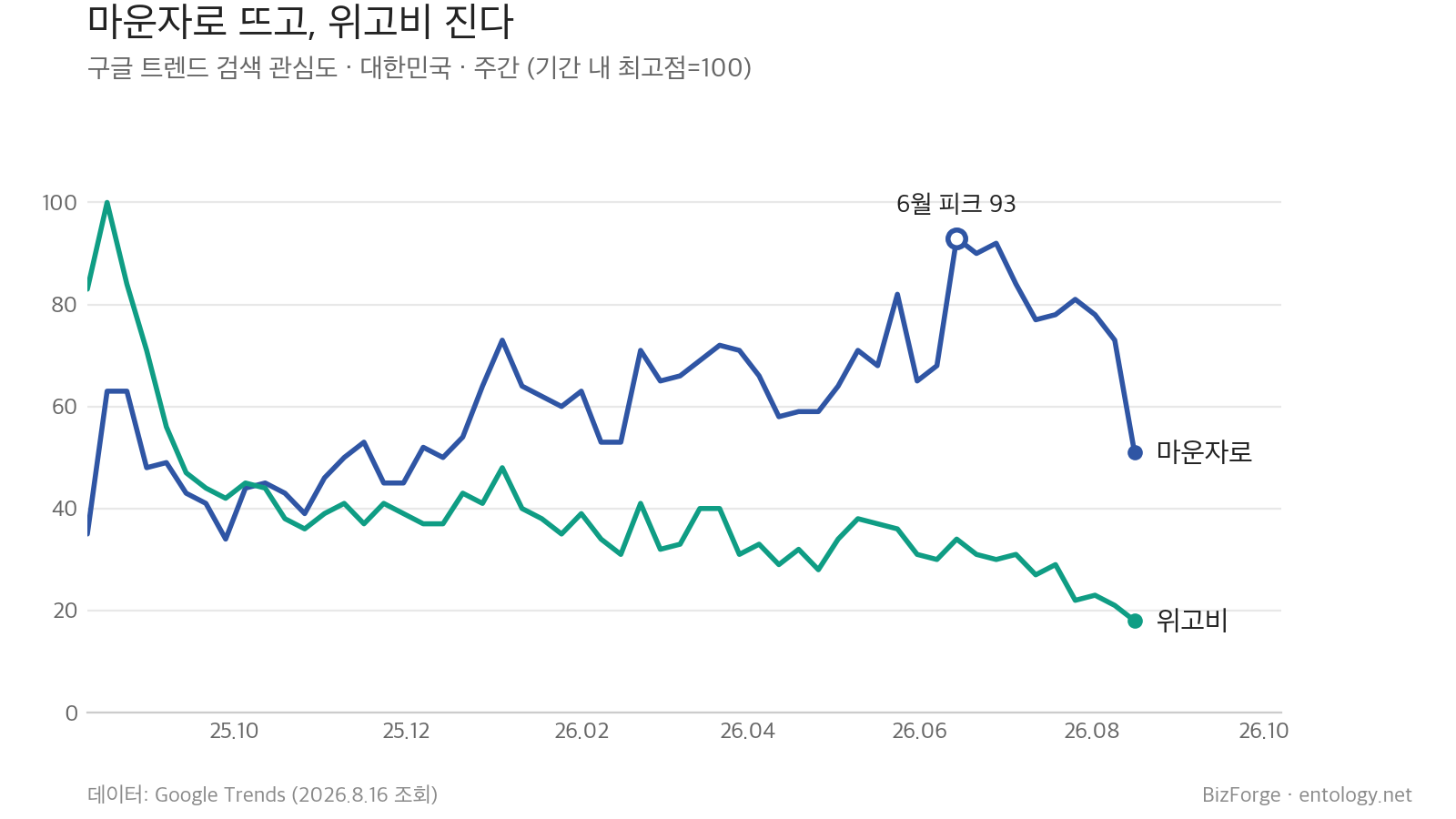
The chart is the original from the Korean report, so its labels are in Korean: 마운자로 is Mounjaro and 위고비 is Wegovy.
A throne changing hands inside one market, printed right there in the search data. More interesting still are the rising related searches attached to Mounjaro:
- "Mounjaro diet" (+46,850%) — the star of this report
- "Mounjaro pancreatitis" — fear of side effects
- "Mounjaro how to use", "Mounjaro 2.5", "Mounjaro 7.5 price" — dose, cost, routine
- "Doctor Now" (a Korean telemedicine app) — remote prescriptions
People are not just searching for the drug's name. They are searching for how to live with the drug. One note: Google Trends does not reveal age or gender — later on, the synthetic consumer data fills that in.
2. Why do they search? — five real reasons found in reviews
We collected what consumers said in their own words across thousands of Mounjaro reviews on Naver blogs.
① Fear of muscle loss and hair loss — The line "Mounjaro diet! If you don't want your hair to fall out, eat all three meals" circulates from review to review. The fear of protecting muscle and hair in a body that is shedding weight fast.
② The paradox of eating less — Appetite is suppressed, but the clinic demands "fewer carbs, more protein, three meals." You can't eat, yet you must. The guilt of "isn't this almost cheating?"
③ Anxiety about side effects — Nausea, bruising at the injection site, and the spike in "pancreatitis" searches. People read the side-effect leaflet closely and compare symptoms with strangers in forums.
④ The pilgrimage for a cheaper price — "Cheapest prescription" reviews are a genre of their own. Prices differ from clinic to clinic, so people shop around and manage a monthly spend of hundreds of thousands of won.
⑤ The once-a-week routine — People give their injection day a nickname ("Thursjaro"). Changing the date, storing, disposing — a self-run weekly routine has appeared.
Put through BizForge's four-forces analysis (what pushes people to change, what pulls them, and the anxiety and habit that hold them back): the push is "the misery of forcing food down and the worry about health getting worse," and the pull is the imagined "perfect nutrition finished in one light bite." On the other side stand anxiety ("will it really fill the nutrition gap, or is it a waste of money?") and habit ("grabbing something from the convenience store as usual").
3. Translating into needs and wants
To turn reasons into business material, they have to be translated into "the job these people are trying to get done." Three layers came out of the analysis.
- Functional need — "Meet daily essential nutrition in a small amount that is easy to swallow." A problem of density, not quantity. (①⑤)
- Emotional want — "Ease the anxiety about hair and muscle loss and the guilt of not eating properly." (②③)
- Social need — "Look like someone who lost weight healthily — not sick, not gaunt." (①)
Lay today's products over these three layers:
| Function (nutrition in a small amount) | Emotion (less anxiety and guilt) | Social (looking healthy) | |
|---|---|---|---|
| Protein bars and shakes | ✕ big, sweet, fishy smell — too much when you eat little | △ bloating turns into guilt | △ |
| Convenience-store eggs and tofu | △ too much, leftovers | ✕ guilt every time you throw some away | △ |
| The empty seat | ○ | ○ | ○ |
The whole existing protein market is designed for people who eat more (people who work out). There is nothing for people who eat less — that is the unmet gap.
4. An idea that fills the gap
We ran an AI divergence-and-convergence pass with the five needs and wants as seeds. High-temperature models produced 12 candidates, and a judge model filtered them with four tests for latent demand. The survivor:
Bite Stack
A subscription of bite-size nutrition cubes for "people who eat less." Not a meal replacement — it completes the nutrition of the meal you couldn't eat, in one bite.
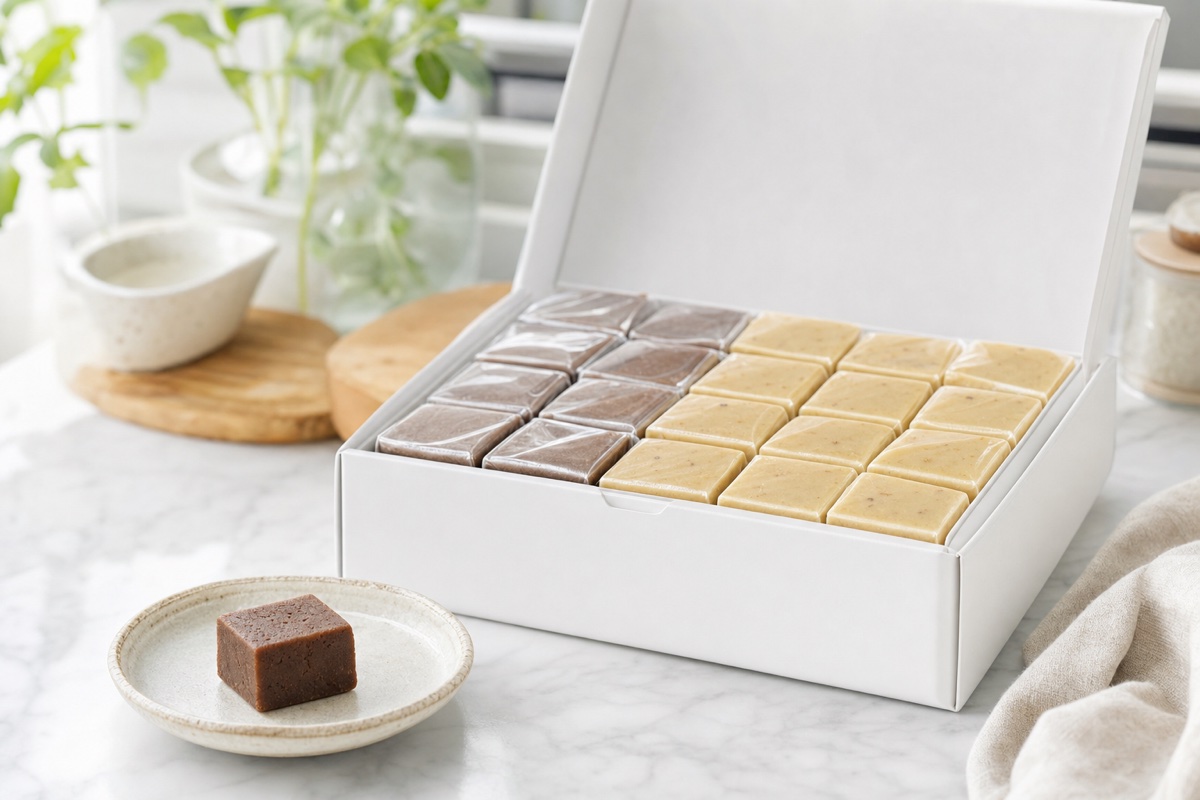
Concept rendering (AI-generated). This product does not exist yet — which is why you are free to take it.
- Form — 2.5 cm bite-size cubes, individually wrapped. Moist and soft like a Japanese wagashi sweet — the opposite of a protein bar that sticks in your throat.
- Contents — about 10 g of protein per cube plus the micronutrients that run short during rapid weight loss (biotin, zinc, magnesium and so on). Low sugar, unflavored by default.
- Quantity — a box of 15 cubes a week. Two or three a day to top up the meals you missed — "an amount you can actually finish" is the core spec.
- Storage — room temperature. No fridge space, no throwing things out because the date ran out.
The details are reverse-engineered from the hesitations in the survey. "It'll be dry and stick in my throat" → the moist wagashi-style texture and small packs. "I can't trust the ingredients" → full disclosure of ingredients and amounts. "More expensive than regular food" → the comparison with the cost of food thrown away, in the price table below. Note: this is an ordinary food, not a drug or a functional-health product — claims like "improves hair loss" cannot be made, and we do not make them.
The runner-up was "Injection Diary" — an app that records how your body feels for 30 seconds a day across the seven days of each weekly injection cycle and compares cycles. A good idea with retention built into the product, but the moment it looks like it is judging a "normal range," it touches the edge of medical-device regulation. If you take it, mind that line.
Now the hypothesis — "Will people pay ₩30,000 (about $21) a month for nutrition cubes made only for people who eat less?" — we ask synthetic consumers first.
5. We asked 100 synthetic consumers
From a corpus of one million synthetic consumers, we searched for "people who struggle to get enough nutrition during rapid weight loss or loss of appetite." Out of 1,200 candidates, 100 were confirmed — spread from their 20s to their 50s (median age 34), close to half men and half women.
One honest note: the market signal for this search was "moderate," not the top grade. It means GLP-1-derived needs are still a niche. Niche is not bad — it tells you where to focus marketing (communities, not mass advertising).
The key results of the eight-question survey:
The pain is real, but it is not one lump — it split four ways. The fishy smell and liquid bulk of shakes, the misery of forcing food down, the bloating from supplements, and the waste of buying food and throwing it away — the discomfort was spread evenly.
❝It feels like my body is wasting away, so I force myself to eat, but swallowing is torture and I just want the meal to be over.❞ ❝Because of the injections my doctor prescribed I have no appetite at all. Shakes won't go down, so I'm getting by on tofu.❞
The will to switch was clear. "Stop what I do now and switch completely" was about half, and "try it alongside" a smaller share — a sign of how deep the fatigue with current options runs. The hesitation split along two axes: the price and the texture — each a smaller share. Those two are the product's first homework.
The unexpected finding: the most urgent voice came from outside GLP-1. A synthetic persona of a single person dieting alone said, "I have no appetite, but I bought a bulk pack of chicken breast, ate less than half, and every time I throw some away I feel the waste and the guilt." This product's real enemy may not be hunger but the guilt in front of the food-waste bin — a signal that the market opens up to single-person households in general.
A note: BizForge results are not real consumer research. They are a simulation built on data from one million synthetic consumers — not the answer, but a compass that shows the direction and the objections before you meet real customers.
6. Conclusion card: price and target
Proposed price — a ₩29,900 (about $21) monthly subscription, plus a ₩9,900 (about $7) first-month starter pack. Acceptance in the synthetic survey concentrated in the ₩20,000–40,000 range (about $14–29), resistance was clear from ₩40,000, and ₩50,000 (about $36) and above was practically absent. The starter pack is the device that gets hesitation number one — "I don't trust the taste and texture" — past the gate at a low price.
Side by side with real retail prices (checked Aug 16, 2026):
| Item | Measured price | Where it sits |
|---|---|---|
| Convenience-store soft-boiled eggs, 2-pack | about ₩2,500 (about $1.80) — the ₩70,000s a month (about $50) if bought daily | Whole food — too much, leftovers, spending scattered |
| Convenience-store protein bar | ₩1,300–2,900 each (about $0.90–2.10) | For people who work out — big, sweet, heavy when you eat little |
| Nestlé Vital Pursuit (USA) | under $4.99 a meal | GLP-1-specific food — exists in the US, not in Korea |
| Bite Stack (our proposal) | ₩29,900 a month (15 cubes a week) | Only for people who eat less — a little over ₩1,000 (about 70 cents) a day |
Nestlé, the world's largest food company, launched a GLP-1-specific brand in 2024 — the strongest proxy evidence that this category is real. And in Korea that seat is still empty. This price is only our proposal; the real answer will come from the starter pack's conversion rate.
Target customers — the center of the niche, and the link that widens it.
- People with sensitive stomachs on medication (core) — unflavored, low sugar, easy on digestion come first. Remaining worry: will the cube stick in the throat or feel dry? Approach: demonstrate the soft texture (video) and disclose all ingredients.
- Single-person households dieting alone (expansion) — exact single servings, storage without waste. Remaining worry: the monthly subscription cost. Approach: a comparison with "the cost of the food you throw away."
Channels, following the response pattern: Naver diet forums, YouTube, and Instagram — as befits a niche, community penetration comes before advertising.
The call — market signal "moderate" plus readiness "medium": not the stage for mass production, but the stage to test the two homework items — texture and price — with a starter pack. The direction itself is backed by the search data (diet +46,850%) and Nestlé's precedent. The fashionable drug will change, but the problem — "nutrition for people who now eat less" — stays.
You can take this idea
Whether it is Bite Stack or Injection Diary, the skeleton laid out today — target, positioning, price hypothesis — is yours to take and start with. An idea is a very small piece of a business. Everything else is testing and doing.
Written by the BizForge team, our Korean edition. We help first-time founders test ideas with synthetic consumer data — a tool that shows which way an idea fails, not one that promises success.
Disclosure — This report is not medical information or drug advertising, and it does not recommend any medicine. The business idea stays within ordinary food and daily-life products, not medicines.
Sources
- Google Trends, South Korea, past 12 months (retrieved Aug 16, 2026) — Mounjaro and Wegovy search trends and related searches
- Many Mounjaro reviews on Naver blogs (July–Aug 2026; quotes are paraphrased)
- Price research (Aug 16, 2026): convenience-store soft-boiled eggs — news and reviews (2-pack about ₩2,500, recently rising); convenience-store protein bars — purchase reviews (₩1,300 and ₩2,900); Nestlé Vital Pursuit — Nestlé USA press release (under $4.99, nationwide launch Sept 2024)
Run this on your own idea
This report was made with our Korean edition. On ducira the same steps run on 100 synthetic US customers: the questions they ask, the problems they confirm, who would pay, and one first customer to talk to. Free for the first run.
Survey answers are simulated reactions of synthetic personas, not real customers. Search figures are relative indexes, not absolute volumes.